Editor’s note: Today’s guest post is by Lovorka Čaja and Iva Grabarić Andonovski. Lovorka is a librarian at Dubrava University Hospital in Zagreb, Croatia, passionate about everything libraries represent — freedom, diversity, and open access to knowledge — and a strong advocate for open science. Iva is the Editor of the Food Technology and Biotechnology journal, a diamond open-access international journal that is a signatory of the UN SDG Publishers Compact.
Academic conferences are essential to scholarly publishing, providing spaces for sharing research and building professional networks. However, in-person events carry a significant environmental burden through waste generation, energy use, and the carbon emissions associated with travel. Therefore, there is a growing need to implement sustainability practices in the organisation of academic events. Inspired by the recent article, Five Tips for Hosting a Sustainable Event by Stephanie Lovegrove Hansen in The Scholarly Kitchen, we were encouraged to describe the efforts taken in organising what we consider the most sustainable EASE conference to date.
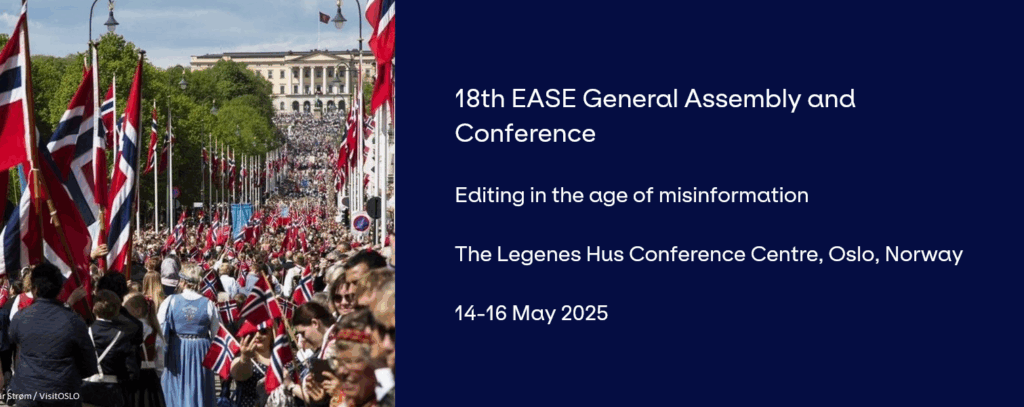
In May 2025, the European Association of Science Editors (EASE) held its 18th General Assembly and Conference: Editing in the age of misinformation in Oslo, Norway. It featured 12 sessions, over 30 speakers, and more than 100 delegates from all over the world.
The EASE General Assembly and Conference is a biennial event that brings together EASE members, Council representatives, committee members, National Chapters, Special Interest Groups, sister societies, and all individuals interested in the latest trends in scholarly publishing and editing. The conference is hosted each time in a different European city, and every edition requires a considerable organizational effort. When considering the diverse circumstances and cultural differences across countries, organizing such an event is always demanding. One of the important aspects is the commitment to sustainability. More and more conferences are adopting green policies and responsible resource management. With the same seriousness, the Organizing Committee of the 18th EASE General Assembly and Conference recognized the importance of such initiatives.
Even though sustainable practices had already been introduced at previous EASE events, the Norwegian context, with its strong personal and institutional awareness of sustainability, provided the perfect opportunity to take it a step further. The EASE Environment and Sustainability Committee was invited to help navigate organizational processes to make this event as sustainable as possible. Over the course of a few months, the committees worked together to plan, coordinate, and implement the proposed initiatives. An important task was to be compliant with the UN Sustainable Development Goals.
Everything was considered — from fostering a diverse and inclusive scientific community (SDGs 4, 5 and 10), reducing travel carbon footprint (SDGs 11 and 13), using digital Conference materials and environmentally friendly gifts for the delegates (SDGs 12 and 14), to sustainable catering, recycling, saying no to single-use plastics (SDGs 12 and 13) and supporting reforestation by planting 214 trees through the EASE Global Forest initiative (SDGs 13 and 15). Global participation was supported with 20 sponsored online spots, which were taken up by early-career researchers and professionals from low- and middle-income countries, including 13 from Africa, 4 from Asia, 1 from South America, 3 from Europe, and 1 from the United States. Travel carbon footprint was also reduced by enabling online participation of the delegates.
The Conference was held in the Legenes Hus Conference Centre, which is situated in the Oslo city center, near the main public transportation routes (tram, bus, metro). Invited speakers and organisers were accommodated in a hotel within walking distance of the Conference Centre. Given that Oslo is a walkable city, participants were encouraged to walk between their hotels and the venue, reducing the need for motorized transport and keeping the event’s carbon footprint low.
- The catering service provider was local and actively supported food redistribution and other sustainable practices, ensuring minimal environmental impact. Food was prepared from the local products, dominantly of plant origin, and all tableware was reusable. Delegates were encouraged to bring their own water bottles, and tap water was provided during coffee breaks. Recycling bins for all types of waste were installed in line with Norway’s national recycling program.
- Conference sponsors were encouraged to minimize the distribution of printed material. Conference posters were printed on recycled and acid-free paper. The initial idea to display posters digitally on TV screens was eventually set aside due to the associated costs and energy consumption.
- There were no conference gifts (such as welcome bags or leaflets); instead, 214 trees were planted by the EASE Global Forest initiative through Borneo Nature Foundation and Plant for the Planet — Yucatán Restoration, as gifts for the 18th EASE Conference delegates and poster winners. One of the most challenging aspects of organizing a sustainable conference is managing the environmental impact of participants’ traveling.
- Since the Conference brings together delegates from all over the world, air travel often remains unavoidable, significantly increasing the event’s carbon footprint. Unfortunately, there is no simple way to resolve this issue, and it does not depend only on the efforts of the Organizing Committee. The delegates were advised to plan their trip using a carbon emission calculator and choose a travel option with minimal environmental impact.
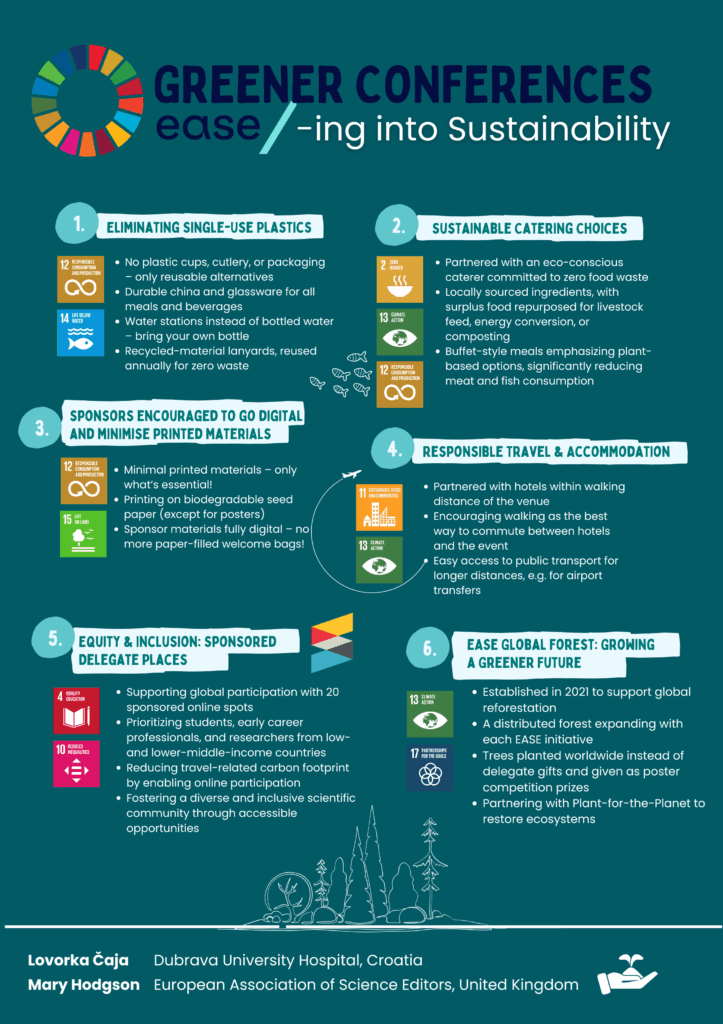
As a result of a joint action of the EASE General Assembly and Conference Organizing Committee and EASE Environment and Sustainability Committee, a conference poster, Greener Conferences: EASE-ing into Sustainability, was created and presented at the Conference.
Encouraged by the positive feedback at the Conference, the EASE Environment and Sustainability Committee decided to develop a set of guidelines for reducing the environmental impact of the academic events, compliant with the UN Sustainable Development Goals. The goal is to create the guidelines and then adapt them into a checklist for easier use. The EASE E&S Committee plans to publish the guidelines by mid-2026.
The success of recent EASE E&S Committee initiatives for sustainable organizational and editorial practices, especially the EASE SDG Checklist developed with the EASE DEI Committee, which offers actionable steps for journals and publishers, is encouraging us in our efforts to raise awareness about the SDGs. Recently held joint EASE E&S Committee and STM webinar has tackled the issue of calculating the carbon footprint of digital publishing, and introduced the newly developed STM’s Digital Carbon Calculator, which can easily be used by any journal or publisher. Such joint activities are a key to reaching the Sustainable Development Goals, and are the best example of how to achieve SDG17 (Partnership for the Goals).
Acknowledgements: Many thanks to Haseeb Irfanullah for serving as Chef reviewer for this guest post.