Editor’s note: Today’s post is by Lorna Notsch and Beth Richard. Lorna is Senior Digital Accessibility Specialist at Sage. Beth is Product Manager for Content Accessibility at Elsevier.
The STM Association Alt Text Task & Finish Group (TFG) is excited to share its draft image-type taxonomy for scholarly images for comment and feedback. This taxonomy is a collaborative effort by members of the STM Association to develop a comprehensive classification system for images in scholarly publishing. In part, it is intended to assist authors and publishers in meeting the upcoming update to Title II of the Americans with Disabilities Act (ADA), going into effect April 24, 2026, and other global legislation. It also contributes to the industry effort to ensure journal content is as accessible and available to as broad an audience as possible. The following is an example from Creative Commons:
Alt text: Child reaching for the stars.
Image descriptions are an essential feature of accessible publishing, providing a text-based alternative to visual content for users of assistive technology, such as screen readers, as well as for those who may have limited internet bandwidth. Comprehensive descriptions help ensure that everyone can read scholarly communications equitably. They are also required to meet accessibility standards, such as the Web Content Accessibility Guidelines (WCAG), and the legislation based upon them. The ADA Title II update will apply to journal publishers and the images they produce from April 2026.
Key to writing a meaningful image description is the image type: The alt text for a chart differs from that for a relational diagram, medical image, or a photograph, and between subcategories with these: bar, line, pie, etc. Considering the myriad image types that come up in scholarly writing, identifying the image type and how to write alt text for such an image is an important first step. This post introduces a draft image-type taxonomy for scholarly images that is intended as a resource for authors and publishers, and a call for feedback from the scholarly community. Neither this document nor its content has any legal status, and neither is intended as legal advice.
Introducing the image-type taxonomy
The STM Alt Text TFG began in early 2025 as an initiative by the STM Association’s STeC (Standards & Technology) Committee, and currently has 18 members from across European, UK, and US scholarly publishers. Members have met monthly to develop the image-type taxonomy, and the resulting draft product combines input from journal experts as well as accessibility specialists.
Arranged in a hierarchy with 15 top-level categories, the goal of this taxonomy “is to establish a controlled vocabulary of image categories commonly used in scientific and scholarly publishing to assist publishers in providing self-serve guidance and examples to authors to assist them in writing alternative (alt) text for images they submit to books and journals.” Each of the 15 categories features a high-level description of the category, guidance for writing alternative text for the category, a representative image with sample alt text, and a list of any subcategories. It is hoped that, in time, a library of samples will be available for not only primary categories but subcategories as well.
Example From the Taxonomy
The following is an excerpt from Category 11 of the taxonomy, including the first of 15 subcategories.
Category 11: Relational Diagram
Shows connections between parts.
Related term: Concept diagram
Guidance for writing alt text
Name the type of diagram and identify the key entities with a description of how they are connected.
Example (11.2 Flowchart)
From: Jasna Jankovic/Jürgen Stumper (2023). Introduction. In: Jasna Jankovic/Jürgen Stumper (eds.). PEM Fuel Cells. Characterization and Modeling. Berlin/Boston: De Gruyter, 2. Courtesy of the authors.
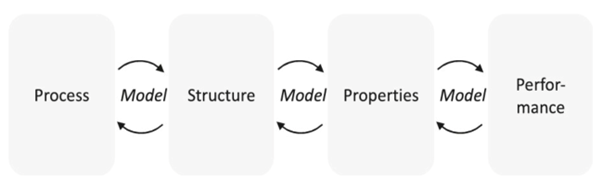
Caption: Schematic illustration of a Process-Structure-Property-Performance (PSPP) approach for fuel cell component design. Using models/correlations (i) performance can be predicted based on stack component physico-chemical properties or (ii) performance targets can be cascaded down into requirements for physico-chemical properties and further to parameters for the structure and manufacturing process.
Alt text: Flow chart with 4 boxes reading left-to-right, “Process”, “Structure”, “Properties”, and “Performance”; between each of them, two arrows (bidirectional) and the term “Model”.
Subcategories of Relational Diagram
11.1 Dendrogram
A tree-like diagram, often used to show taxonomic relationships.
Call for Community Feedback
To develop truly inclusive solutions for accessible publishing, it is essential that a wide range of organizations have input into industry tools. The STM TFG therefore welcomes feedback on the draft taxonomy. This draft taxonomy can be found on the Alt-Text Task & Finish Group page. It is also linked from the STM announcement, which includes a link to a feedback form incorporating this set of questions to consider while reviewing the document that has been created.
- To what extent do you think this taxonomy will be helpful for authors in writing alt text for images submitted to books and journals?
- To what extent do you find the taxonomy’s hierarchical structure (top-level categories with subcategories) clear and easy to navigate?
- Are there any aspects of the taxonomy that seem overly complex or difficult to understand?
- Are there any types of scholarly images not covered by the taxonomy (as a top-level or subcategory)?
- Is the guidance for writing alt text for each category helpful and actionable?
- Do you find the inclusion of example images with alt text examples useful for understanding the taxonomy?
- Are there any areas where you feel the taxonomy could be improved (e.g., structure, content, or usability) or expanded?
- Are there any additional resources or tools that would help improve the utility of the taxonomy?
- Do you have any other comments or feedback that you would like to share?
The comment period is open until February 28, 2026. Following that, the STM Alt Text TFG will review and synthesize the comments and refine and update the taxonomy. We look forward to receiving your feedback before the taxonomy is made available to the wider community.


Discussion
2 Thoughts on "Guest Post — Call for Feedback: STM Task & Finish Group (TFG) Image-type Taxonomy for Alt Text"

Thank you, Lorna and Beth. Feedback-wise, this does feel like a valuable initiative. Such a taxonomy can also help situate GenAI describers to make their alt-text first drafts better quality because they are better aware of the context of an image. To make this more inclusive of AHSS publishers, this resource put together a few years ago to help with humanies book accessibility may suggest some other high level categories of image: https://share.google/cYPEpxSvrZe44YzGL

Thanks Charles, we will be sure to pass on this humanities resource to the STM group.