Editor’s note: Today’s post is by Ashutosh Ghildiyal, Gareth Dyke, and Maria Machado. Ashutosh is the Vice President of Growth & Strategy at Integra. Gareth is a researcher, author, and scholarly communications consultant. Maria is a physiologist turned consultant, helping researchers publish their findings quickly. Reviewer credit to Chef Dianndra Roberts.
Envisioning a World Where Science Communication Thrives
Imagine a world where scientific breakthroughs don’t vanish behind paywalls or suffocate under jargon. A world where discoveries flow seamlessly from the lab bench to everyday conversations, where people make informed choices based not on speculation but on evidence. In this world, scholarly publishers flourish because their work is indispensable to public discourse.
This isn’t utopian thinking; it’s a strategic imperative. The scholarly publishing industry stands at a crossroads. Our future depends on mastering science communication with the same rigor that global consumer brands apply to marketing. This depends on being able to quickly and effectively assess a piece of research and simply describe how and why it is relevant. We are permanently inundated with information, so what do we decide is important? This is effective science communication.
In this future, knowledge doesn’t remain trapped in academic silos. It becomes a living part of public consciousness. Communication is no longer an afterthought — it is the driving force that determines whether discoveries have a meaningful impact.

The Misinformation Economy
Today’s communication failures are not just missed opportunities; they represent an existential threat to the long-term viability of scholarly publishing. When publishers fail to support effective research communication, misinformation fills the gap. Anti-vaccine movements, climate denial campaigns, and health myths succeed not because science is wrong, but because scientific voices are often absent, inaccessible, or incomprehensible.
Every viral piece of misinformation erodes public trust in legitimate research, dragging along the publishers who disseminate it. This is direct market competition from those who understand communication psychology far better than most scientific institutions. Publishers must learn to compete in this communication marketplace, or risk losing relevance and support, as well as revenue. Indeed, poor communication fuels a vicious cycle that threatens publisher revenue:
- Inaccessible research reduces public understanding and support.
- Weak public support drives political pressure to cut research funding.
- Reduced funding forces institutional budget cuts.
- Libraries cancel subscriptions, squeezing publisher revenue.
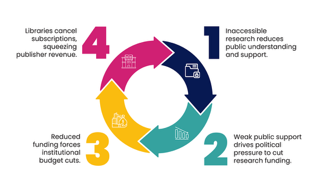
Universities are questioning whether costly journal subscriptions provide value when research remains unintelligible to students, cross-disciplinary faculty, and external stakeholders who might have otherwise benefited. Publishers who cannot demonstrate broad impact and accessibility face increasing cancellation pressure (especially medium-to-small publishers who might survive from ‘nice to haves’ in library budgets).
As information becomes democratized and alternative voices gain influence, traditional publishing models face rising questions of relevance. Publishers whose content cannot be understood easily or applied by those who need it risk marginalization, as essential infrastructure gives way to more accessible alternatives.
Beyond the Traditional Journal Article
Publishers are content disseminators, while researchers are content creators and consumers. People out in the wider world, however, have always been the most important, primary consumers of content. We argue that publishers are uniquely positioned to play a catalytic role by transforming how researchers engage with broader audiences.
As such, the research paper should become the centrepiece of a comprehensive communication ecosystem, and not its sole resource. These communication modalities consist of plain-language summaries, podcasts, and video explainers, offered as premium services to expand reach. These multi-format content packages should be developed for specialized audiences — practice guides for clinicians, policy briefs for government officials, and educational materials for students. Because publishers are able to gather skills and capabilities to create novel interactive data visualizations, infographics, and professional video abstracts, these products can then be licensed to different markets, therefore justifying their budgets and multiplying revenue per publication.
Publishers can also partner with institutions to establish communication impact metrics that move beyond traditional citations, and create demand for demonstrably broader content engagement. This latter concept, as yet little validated, is nevertheless a valuable form of impact that institutions and funders are starting to recognize. Here too, publishers can collaborate with universities and specialised educators to provide researchers with media training and narrative development skills. Science communication training is essential in the digital age, and effective training should be a professional skill, not a luxury. These publishers can then become true partners in career development.
Publishers can also transform the traditional researcher–journalist relationship from adversarial to collaborative, positioning themselves as essential intermediaries in knowledge brokering. By integrating communication review alongside peer review, publishers can ensure published research meets both scientific rigour and communication excellence standards.
This approach unlocks multiple revenue streams and positions publishers as comprehensive communication partners, rather than simple content distributors. Publishers are uniquely positioned to help researchers leverage social media professionally, as they can potentially provide authors with multimedia assets, social media training, and coordinate social media campaigns.
Publishers as Enablers of Evidence-Based Decision-Making
Those who facilitate translation from research to practice position themselves at the centre of knowledge application. Publishers can create healthcare apps, policy frameworks, and professional guidance tools based on their published research, which could then be licensed to healthcare systems, governments, and professional organizations. The Cochrane Library is a gold-standard example of a knowledge synthesizer. Their systematic reviews are foundational to evidence-based medicine and are used by health systems worldwide to create treatment guidelines.
Publishers can also offer research synthesis and evidence review services to organizations needing authoritative guidance by leveraging their content portfolios and author networks. One obvious example here is the BMJ’s Technology Assessment Group (TAG). Major publishers have developed services and platforms specifically to support the creation of systematic reviews, a key form of research synthesis. Elsevier’s Mendeley and Wiley’s Covidence are tools designed precisely for this process.
The advantage of leveraging the size of the publishing industry lies in its formal relationships with healthcare systems, policy organizations, and industry groups. Elsevier’s ClinicalPath and Sage Publishing’s partnership with the American Psychological Association (APA) are good examples. These publishers were able to provide ongoing research intelligence and consultation, all the while identifying high-value research topics for future commissioning.
Publisher-Driven Public Engagement
Community platform development has facilitated ongoing dialogue between researchers and public stakeholders, but publishers can transform public engagement into a revenue driver while aligning themselves with the UN’s SDGs. Springer Nature’s “Communities” and “BioMed Central Blogs” are good examples, alongside Sage Publishing’s “Methodspace,” since they build brand loyalty and generate subscription revenue from engaged communities.
Conferences, webinars, and public lectures also bring together researchers and other stakeholders. Cell Press runs a global series of scientific conferences that are closely tied to their journals’ themes. The Lancet’s numerous global health events and summits showed that hosting these networking opportunities generates direct revenue for publishers and strengthens institutional relationships.
Nevertheless, publishers can do more by developing citizen science initiatives around their research areas. These create new content streams, build engaged communities, and provide market research insights, such as The Zooniverse Platform and the “Evolution MegaLab,” which was developed in collaboration with The American Naturalist.
When publishers become essential partners in translating knowledge into action, they evolve from content providers to indispensable infrastructure for evidence-based decisions — a true foundation for creating sustainable, high-value business models that are participation-based, build long-term trust and loyalty, and can protect against subscription cancellations and budget cuts.
Implementation Roadmap
Publishers should begin by auditing their current communication effectiveness and benchmarking against industries skilled at simplifying complex information. This requires robust tracking systems to measure ROI and stakeholder impact.
It also means analysing reach, engagement, and impact metrics while identifying high-performing author-communicators as role models. Over the next year, publishers must invest in professional communication teams, multimedia production capabilities, and comprehensive author training programs. This would work optimally if accompanied by piloting new content formats, like video abstracts, podcasts, and interactive visualizations.
In the longer term, publishers must evolve into comprehensive communication platforms that provide tools, services, and consulting across the research lifecycle. This new, revised role would open new revenue streams, deepen institutional relationships, and establish industry leadership through standards and best practices that strengthen the entire scholarly ecosystem.
The Strategic Imperative
The scholarly publishing industry faces a defining inflection point. Traditional business models are under strain from budget constraints, shifting stakeholder expectations, and the rapid spread of misinformation. Simply producing and distributing content is no longer sufficient for sustainable business success.
Publishers that treat communication as optional risk sliding into irrelevance, while those that embrace it as a core competency will secure both research impact and business sustainability. Science communication is no longer a soft skill or optional add-on; it emerges as the next competitive advantage in scholarly publishing. Publishers that seize this opportunity will shape the future of knowledge, becoming the vital link between research and society. The most successful publishers will invest in professional communication capabilities, build multimedia content ecosystems, and cultivate authentic relationships with diverse stakeholder communities.
Communication must now be treated with the same rigour as peer review and editorial quality. Tools, techniques, and proven models already exist — from Apple’s ability to make complexity inspiring, to consulting firms’ mastery of simplifying ideas and leading with insight. The choice is not whether transformation is possible, but whether publishers will lead or be forced to follow.
Publishers who act decisively will reinforce their role as trusted connectors between science and society, gain visibility for the research they steward, attract top-tier submissions, and create new revenue streams through multimedia and education services. The future belongs to publishers who recognize that scientific excellence without communication excellence is insufficient for business success.
Discussion
1 Thought on "Guest Post — Why Science Communication Must be the Next Competitive Edge for Scholarly Publishers"

Yes. Communication is very important. Nice work Gareth!