An editor asks AI to summarize a stack of reviewer reports before reading them herself. Days later, reviewing her own decision, she finds herself wondering whether the judgment she reached was fully her own. That small moment points to a much larger question now facing scholarly publishing.
Generative AI has transformed scholarly publishing in under three years. Yet despite thousands of articles, webinars, conferences, and policy discussions, there remains little clarity about which kinds of cognition AI can perform and which must remain human. Discussions about AI often become polarized: some treat it as capable of replacing an ever-expanding range of cognitive work, while others emphasize its limitations and risks. Both perspectives can obscure a more fundamental question: what kinds of cognition can AI actually perform, and where must human responsibility remain?
AI is now a permanent feature of the scholarly landscape. The question is no longer whether it should be used, but how it should be understood and governed.
This article begins from the premise that not all cognition is the same. Some cognitive tasks involve pattern recognition, retrieval, and mechanical processing. Others require discovery, discernment, and original insight. These forms of cognition are not simply different in degree; they are different in kind. AI can retrieve, recombine, and generate from existing knowledge in increasingly sophisticated ways, but it cannot originate the inquiry, judgment, or insight that gives those capabilities their value. For authors, reviewers, editors, and publishers, understanding that distinction is one of the most important governance challenges of the AI era.
The Cognitive Responsibility Framework proposed here is a conceptual framework for governing human–AI collaboration in scholarly publishing. In a previous post in The Scholarly Kitchen, Before the Guardrails: Why AI Governance in Research Must Start with Purpose, I introduced an early distinction between mechanical cognitive work, which AI can increasingly perform, and judgment-based cognitive work, where human responsibility must remain central. This article builds on that distinction. Part 1 develops the conceptual hierarchy and examines where the boundary lies. Part 2 explores what happens when that boundary is repeatedly ignored: what this framework calls cognitive debt, the gradual erosion of the cognitive capacities that give scholarship its meaning.
The framework is not intended to classify people or rank scholarly activities. Rather, it offers a practical vocabulary for deciding where AI can appropriately extend human cognition and where human responsibility must remain primary. Readers who disagree about the precise nature of intelligence or discovery may still find the framework useful, because its purpose is governance, not cognitive science.
A note on what this framework is and is not: this is an opinion piece, not a scientific claim. The distinctions it draws, between thought and intelligence, between mechanical and non-mechanical cognition, are conceptual heuristics, and the boundary between them will rarely be as clean in practice as a hierarchy diagram suggests. Cognitive debt, introduced in Part 2, is likewise offered as a risk to watch for, not a measured or validated metric. The purpose of the framework is not to settle these questions empirically but to give editors, reviewers, and publishers a shared vocabulary for asking them.
A Conceptual Hierarchy of Human Cognition
Why does this matter for publishers? Every editorial workflow ultimately involves deciding which forms of cognition can appropriately be delegated to AI and which cannot. The framework that follows provides a practical way of making those distinctions.
For the purposes of this framework, intelligence refers to the governing faculty that directs and evaluates thought, rather than to psychometric ability or general reasoning as measured by IQ.
Within this framework, AI functions as artificial thought. Thought, whether human or artificial, is the acting faculty of cognition. It retrieves, compares, combines, analyzes, and generates possibilities from what is already known, but it cannot determine which possibilities deserve trust or action. Intelligence provides that direction, evaluating thought and recognizing when existing patterns must give way to discovery, discernment, and new understanding. The distinction is offered as an operational model for cognitive governance rather than as a comprehensive theory of mind.
Intelligence draws upon every form of cognition, operating through discovery and discernment without being reducible to any of them. It enables a researcher to recognize when a theory no longer fits the evidence despite appearing internally consistent, or when an accepted consensus is preventing important questions from being asked. The other forms of cognition do not accumulate into intelligence; they are the means through which it operates.
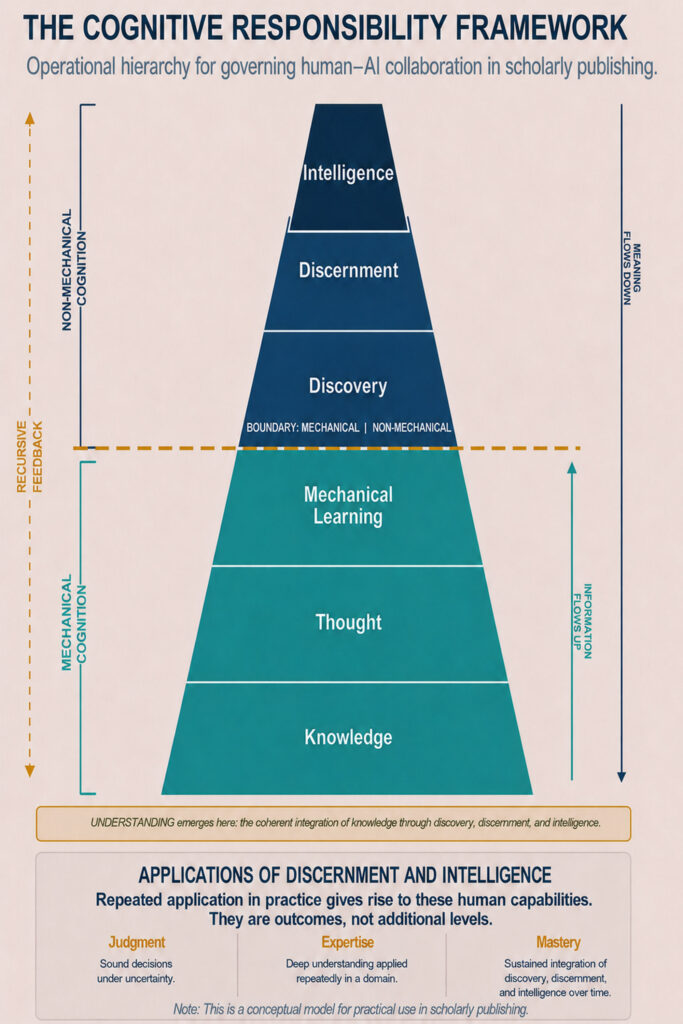
The framework should not be understood as a collection of independent cognitive faculties operating in sequence. Rather, it describes different functions within a single integrated cognitive system. Scholarly activities move fluidly across these functions, making the distinction between mechanical and non-mechanical cognition a useful guide rather than a rigid boundary.
This ordering resembles David Bohm’s distinction between machines and living organisms. In a machine, the parts are assembled to produce a functioning whole. In an organism, the whole continuously organizes the activity of its parts. Likewise, knowledge, thought, discovery, discernment, and intelligence remain continuously interconnected: higher forms of cognition organize and direct lower ones, while the system as a whole operates through continuous feedback.
Knowledge and thought together constitute mechanical cognition: the capacity to store, retrieve, organize, and manipulate information through recognizable patterns. It is repetitive, trainable, and content-based, operating on knowledge that can be accumulated, transferred, and scaled. Non-mechanical cognition refers to the forms of cognition grounded in discovery, discernment, and judgment through direct engagement with evidence. These forms are context-sensitive, qualitative, and awareness-based; they depend on direct observation, reflection, and tacit understanding. Thought constructs possibilities from what knowledge provides. Discovery and discernment provide the context, meaning, and purpose that direct thought, determining which possibilities correspond to reality and deserve trust.
Learning illustrates the boundary between these two domains. One form extends what is already known through repetition and refinement, and AI increasingly performs this kind of learning by strengthening pattern recognition and prediction. The other is discovery: the universal human capacity to let experience revise what prior knowledge suggests. A child encountering a bird for the first time exercises the same essential cognitive process as a scientist who watches unexpected evidence overturn an established theory. Discovery is not a specialist skill but the willingness to let observation reshape understanding. As perception changes, discernment begins.
Discovery provides new encounters with evidence; discernment determines their significance, evaluating not simply what information exists, but whether it is true, significant, and well-founded. Consider a journal editor reading a manuscript on a contested topic. Discernment allows the editor to recognize that the data are sound while the conclusions overreach, or that the methodology is genuinely novel despite a cautious framing.
Understanding is the fruit of discovery and discernment: the coherent integration of knowledge that emerges when experience has been tested against evidence. Applied repeatedly to decisions under uncertainty, discernment gives rise to judgment. Throughout this process, intelligence remains the governing faculty. It determines how thought responds to what discovery and discernment reveal, recognizing when existing patterns remain sufficient and when they must give way to new insight. Knowledge accumulates through thought; meaning, purpose, and direction flow through discovery, discernment, and intelligence.
Mechanical Cognition: What AI Does Well
Mechanical cognition is what knowledge and thought become when applied in patterned, repeatable, and rule-governed ways. Current AI systems excel here. Within our framework, AI is artificial thought. Like human thought at its most systematic, it retrieves, compares, analyzes, summarizes, predicts, and generates; the difference is one of speed, scale, and lack of fatigue. Formatting citations, summarizing manuscripts, screening submissions, extracting structured information, and identifying recurring patterns are all forms of mechanical cognition that AI performs efficiently.
None of this makes mechanical cognition a lesser form of scholarship. Replication studies, systematic reviews, technical editing, and compliance checks derive their value precisely from consistency and repeatability. Where the objective is accuracy and standardization, AI can substantially strengthen human capability.
The same principle applies to scholarly writing. AI can improve clarity, strengthen structure, refine language, and make ideas more accessible. What it should not replace is the original insight that arises from direct engagement with evidence. Expression should remain faithful to insight rather than substitute for it. The value of scholarship lies not only in how clearly ideas are communicated, but in the discovery, discernment, and judgment from which they emerge.
Discovery and Discernment: Learning Beyond Pattern Recognition
AI systems can surface unexpected patterns, identify anomalies, and reveal relationships that researchers later recognize as significant. Within this framework, however, AI recognizes patterns by relating new inputs to accumulated knowledge. It may identify relationships that appear novel to human observers, but within this framework, recognition is treated as distinct from discovery. Discovery begins with direct human engagement with evidence. Discernment then evaluates the significance of that encounter, providing the context, meaning, and purpose that direct thought toward understanding and, ultimately, judgment.
Richard Feynman recalled his father saying that knowing the name of a bird in every language tells you nothing about the bird itself. Within this framework, the name is knowledge. Using that knowledge to identify and describe the bird is thought. Observing the bird directly and letting experience revise prior understanding is discovery. Recognizing that the name is not the bird itself is discernment.
This distinction has immediate implications for scholarly publishing. Take an editor who asks AI to summarize reviewer reports before reading them. The summary may be accurate, but it becomes the editor’s first encounter with the manuscript: an interpretation has already intervened before direct observation begins. Judgment may still be careful, but it is no longer entirely independent, because the initial relationship with the evidence has been mediated. Subtleties that might have emerged through direct reading, a reviewer’s hesitation, a methodological concern, a tension buried in a footnote, may never surface, because AI has already determined what appears most important.
The principle is even more important in peer review. A reviewer who asks AI to evaluate a manuscript before reading it places an intermediary between themselves and the evidence. The resulting review may identify genuine strengths and weaknesses, but its conclusions are no longer rooted entirely in the reviewer’s own understanding. The value of peer review lies not simply in reaching sound conclusions, but in arriving at them through careful reading, discovery, reflection, and judgment.
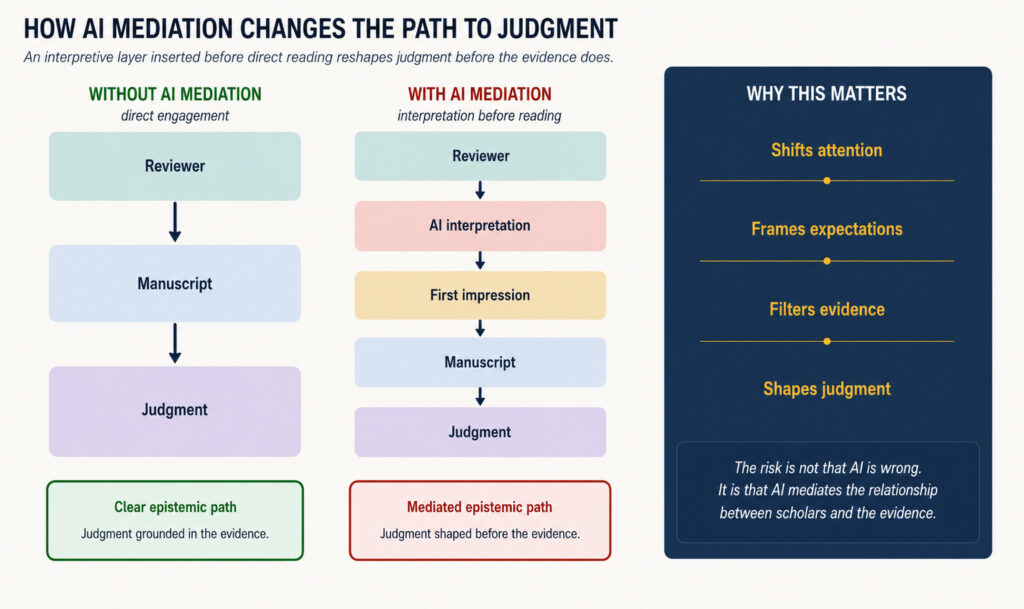
The distinction between mechanical and non-mechanical cognition is therefore more than theoretical. Every time authors, reviewers, or editors decide whether to engage directly with evidence or allow AI to mediate that engagement, they make a choice about cognitive responsibility. Repeated across thousands of scholarly decisions, those choices shape not only individual expertise but also how scholarly institutions learn.
AI Use Disclosure: AI tools were used to assist with editing the text and to support the development of some visual concepts, which were subsequently translated into final designs by a human visual designer. The conceptualization, ideas, arguments, interpretation, storyline, and final editorial decisions are those of the author.

Discussion
7 Thoughts on "Reading Between the Lines, Part 1: A Cognitive Framework for AI in Scholarly Publishing"

I understand the author’s aim in distinguishing between ‘mechanical’ and ‘non-mechanical cognition’.
It may make sense for a rough classification, but (unless one believes that humans possess transcendental components or that consciousness is an independent ontological entity, as David Chalmers argues) the overwhelming scientific consensus is that human cognition arises from biochemical processes in human neural networks. Cognition (including ‘non-mechanical’ cognition) is an emergent property of networks (admittedly, in humans it is closely linked to sensory and physical experiences and hormones, which AI does not possess). In this respect, I can see no fundamental reason why ‘non-mechanical cognition’ should not also be possible (not yet, but perhaps in a few years’ time) in artificial neural networks (especially if training is also to be carried out via sensory input and embodiment in the future). I, too, was a freshly fertilised egg cell around 50 years ago; since then I have absorbed a great deal of information and have (for some time now…) developed ‘non-mechanical’ cognition.

Andreas, thank you for the thoughtful comment. By non-mechanical cognition, I do mean consciousness and I hold the view that it is an idependent ontological entity. I do agree that cognition (including the thinking process) arises from biochemical processes in human neural networks. In the framework used in this article, I consider cognition arising from sensory inputs (human or artificial; emotions can be simulated as well) as part of the mechanical cognition process. However, Intelligence as referred to in this article I would consider part of consciousness which is not measurable and does not depend on material processes.
Dear Ashutosh, thank you very much for your reply.
In that case, it simply means that we have different worldviews or, rather, different conceptions of human nature.
Regarding your statements: “I do mean consciousness and I hold the view that it is an independent ontological entity.” and “However, Intelligence as referred to in this article, I would consider part of consciousness, which is not measurable and does not depend on material processes.”:
I do not believe that consciousness exists independently of matter or material processes; if it did, it would be something transcendental or supernatural. I believe that human beings belong solely to this world (and do not have transcendental or supernatural “components”) and that consciousness is a consequence of neural processes. When these processes are absent (before fertilisation of the egg or following brain death), the consciousness of the individual in question ceases to exist.
Of course, one can from one’s own subjective perspective view this differently , and many religions – and, to a certain extent, David Chalmers too (who sees consciousness as an independent ontological entity) – take this view.
Thanks, Andreas. This is a reasonable way to think about this, and it is currently a commonly held view. I think, however, that it can also be considered an assumption.
We can be sure that consciousness exists because we are conscious. However, we cannot definitively say that consciousness is generated by us. Another possibility is that the organism is a receiver of consciousness, rather than a producer of it, and that the organism depends on consciousness in order to be conscious.
It could also be a non-material quality that pervades and enables the material organism to become conscious of itself. In this view, the brain could be considered an instrument that receives consciousness rather than produces it.
This view is also logically coherent and, at the very least, deserves to be considered. We cannot simply reject it as supernatural because we are unable to define or measure it, while assuming that it must necessarily be subject to the same properties as matter. It could have a different quality and nature altogether. This is a view held by philosophers and, to some extent, by scientists as well.
Quantum physics differs from classical physics precisely because it grapples with questions arising from the limitations of classical physics in explaining quantum phenomena.

I think Andreas makes a really good point here. If “non-mechanical cognition” actually means consciousness, as the author explains, then I would also be careful about drawing such a clear line between human and artificial cognition.
I would also separate intelligence and consciousness more clearly. They are connected, but they are not the same thing. Intelligence seems to exist in different degrees across humans and other animals, rather than being something uniquely human.
Consciousness is a much more complicated question. Depending on how we define it, we can also talk about different forms or levels of consciousness. Some of these may even be possible in AI, without saying that AI has the same kind of conscious experience that humans have.
So I’m not sure we need consciousness to explain intelligence – or that intelligence should be seen as a part of consciousness.
All very valid points, Sarah. Let me reframe this. Sorry, the terminology can be confusing. I think the key question raised by this discussion is whether we are purely material beings—that is, whether consciousness is only a product of physical, chemical, and biological processes. That is one view, which can be called the mechanistic or materialistic view of life and the universe.
The materialistic view considers consciousness to be a process of matter, while the other view considers it to be of a different order than matter—one that can observe and act on matter. The framework described in this article takes the latter view.
Here, the coherence of mechanical cognition (the thought process, which includes identification, recognition, imagination, verbalization, analysis, making predictions based on past patterns, creating new combinations of knowledge, and so on) is dependent on the exercise of non-mechanical cognition. In other words, attention, which is a property of consciousness/intelligence, creates cognitive coherence, whereas a lack of attention creates incoherence and cognitive debt.
Thanks Ashutosh, that helps me understand your position better. I think this is exactly where I would side with Andreas, though.
I have a hard time with the idea that consciousness is something separate from physical and biological processes. To me, that raises the question of what the basis for such a separate form of consciousness would be, and why it should be something specific to humans.
I’m also not sure that this assumption is needed to explain why attention or cognition can be coherent. I would rather see these as properties that emerge from the way a cognitive system works.
So I think we are probably starting from two very different assumptions about what consciousness actually is. And that difference also leads us to very different conclusions about AI.