Cognitive Coherence and Cognitive Debt
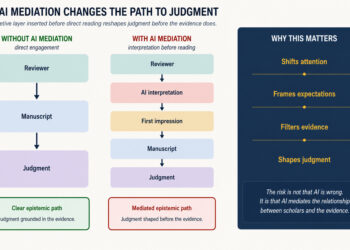
Part 1 of this post introduced the Cognitive Responsibility Framework, distinguishing the forms of cognition AI can increasingly perform from those that must remain human. The choices it describes often look insignificant in isolation: read the manuscript before the AI summary, or after; form an independent judgment first, or let AI shape the initial interpretation. Repeated across thousands of manuscripts, reviews, and editorial decisions, these choices accumulate. The central risk of AI in scholarly publishing is therefore not hallucination but cognitive debt: the gradual erosion of the human capacities that give scholarship its originality, integrity, and meaning.
When the functions of the framework operate in alignment, with discovery testing thought against evidence, discernment evaluating the significance of that evidence, and intelligence directing the process toward coherent judgment, the result is cognitive coherence: the condition in which thought remains continuously accountable to discovery and discernment. Mechanical cognition generates possibilities. Non-mechanical cognition provides the context, meaning, and purpose that direct thought, determining which possibilities deserve trust and action.
The significance of cognitive coherence becomes most apparent through its absence. Every decision to delegate engagement with evidence before exercising independent judgment may seem inconsequential on its own, yet these choices accumulate over time. This gradual outsourcing of discovery, discernment, and judgment creates what this framework calls cognitive debt. Like technical debt in software engineering, the immediate return is efficiency; the long-term cost is the gradual weakening of the capacities that give scholarship its originality and value.
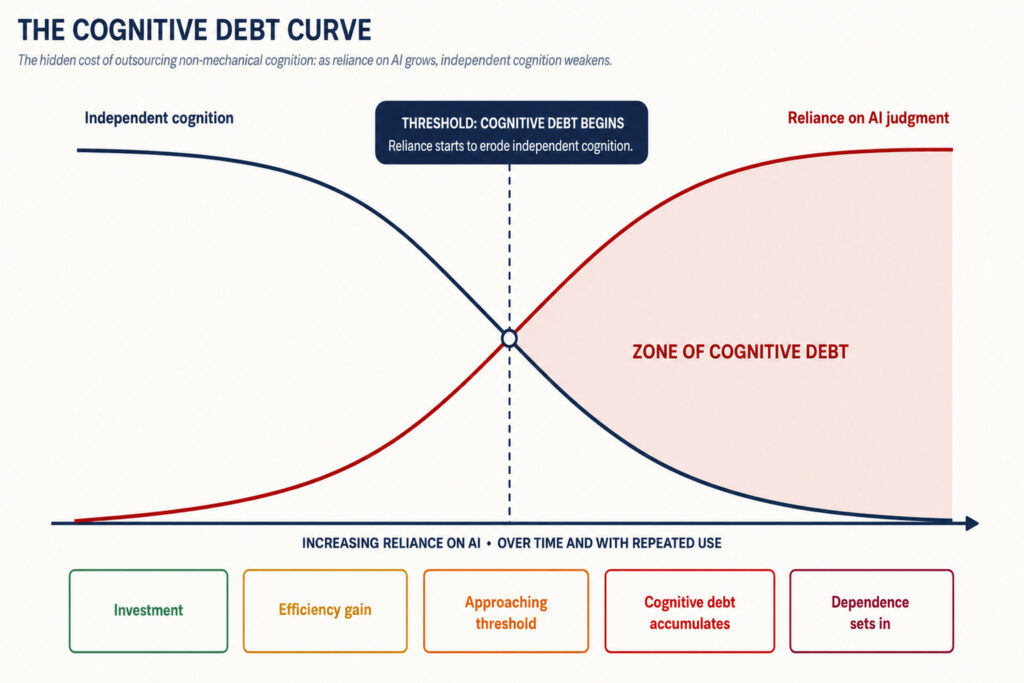
The greater risk, then, is not what AI can do, but what sustained cognitive outsourcing does to us. Non-mechanical cognition does not accumulate like knowledge; it develops only through exercise. These capacities are not fixed possessions but human potential. Discovery matures through repeated engagement with evidence. Discernment develops through distinguishing what is significant from what merely appears convincing. Intelligence is exercised by directing thought rather than being directed by it. Like physical abilities, these capacities strengthen through use and gradually become dormant when consistently bypassed. Cognitive debt is the cumulative consequence of that disuse.
This risk is especially significant for early-career researchers and graduate students, whose discernment develops through repeated engagement with evidence rather than through the passive consumption of synthesized interpretations. Delegating the cognitive work that builds judgment to AI is most consequential precisely when that judgment is still forming.
None of this argues against AI. On the contrary, by assuming much of mechanical cognition, AI creates the opportunity to invest more deeply in discovery, discernment, and judgment. It can reduce repetitive work, coordinate complex tasks, and strengthen consistency, freeing human attention for the forms of cognition that require direct engagement with evidence and responsible intellectual ownership. An editor relieved of hours of reference checking can devote more attention to originality and significance. A reviewer who uses AI to improve the clarity of a report, after independently evaluating the manuscript, communicates more effectively without relinquishing ownership of the underlying judgment. Whether these gains are realized depends entirely on how the cognitive capacity freed by AI is reinvested.
Cognitive debt is therefore not an inevitable consequence of AI, but of misallocation. It arises when mechanical cognition replaces the forms of cognition that give it meaning, rather than supporting them. As artificial thought becomes increasingly capable and abundant, the distinguishing value of scholarship will lie less in producing more information than in preserving the uniquely human capacities for discovery, discernment, judgment, and responsible intellectual ownership.
Implications for Scholarly Publishing
The Cognitive Responsibility Framework can be distilled into six concepts that together describe how cognitive responsibility should be distributed between humans and AI.
| Concept | Meaning |
| Mechanical cognition | Patterned, repeatable cognition that AI increasingly performs. |
| Non-mechanical cognition | Discovery, discernment, and judgment through direct engagement with evidence. |
| Cognitive coherence | The condition in which mechanical cognition remains governed by discovery, discernment, and intelligence. |
| Cognitive debt | The gradual erosion of non-mechanical cognition when it is repeatedly outsourced before it has first been exercised. |
| Adaptive publisher | A publisher that uses AI to automate mechanical cognition while strengthening organizational learning and editorial judgment. |
| Cognitive responsibility | Deciding which forms of cognition AI should support and which must remain human. |
These concepts provide a practical vocabulary for applying the framework across scholarly publishing. Every role combines mechanical and non-mechanical cognition in different proportions. The question is not whether AI should be used, but which forms of cognition it should support and which must remain human.
For authors, AI can strengthen literature discovery, language, formatting, and other forms of mechanical cognition, while responsibility for framing research questions, interpreting findings, and developing arguments remains inseparable from intellectual ownership. Reviewers may use AI to support technical checks or improve the clarity of their reports, but independent evaluation, weighing evidence, and review judgment must emerge through their own direct engagement with the manuscript. Editors can rely on AI for technical screening, reviewer selection support, research integrity checks, and workflow coordination, yet decisions about originality, significance, and publication remain matters of human discernment and judgment.
For publishers, the challenge extends beyond individual editorial decisions to organizational governance. AI should automate mechanical cognition while strengthening, not replacing, the human capacities that determine editorial policy, organizational learning, and stewardship of the scholarly record.
From Automation to Organizational Learning
Publishers face this same challenge at an institutional level. The first task is not simply to deploy AI, but to exercise discernment about where it should be applied. Bottlenecks arising from repetitive coordination, fragmented workflows, inconsistent processes, or critical knowledge concentrated in a few individuals are fundamentally mechanical challenges that AI is well suited to address. Automation scales existing practice; organizational learning transforms it.
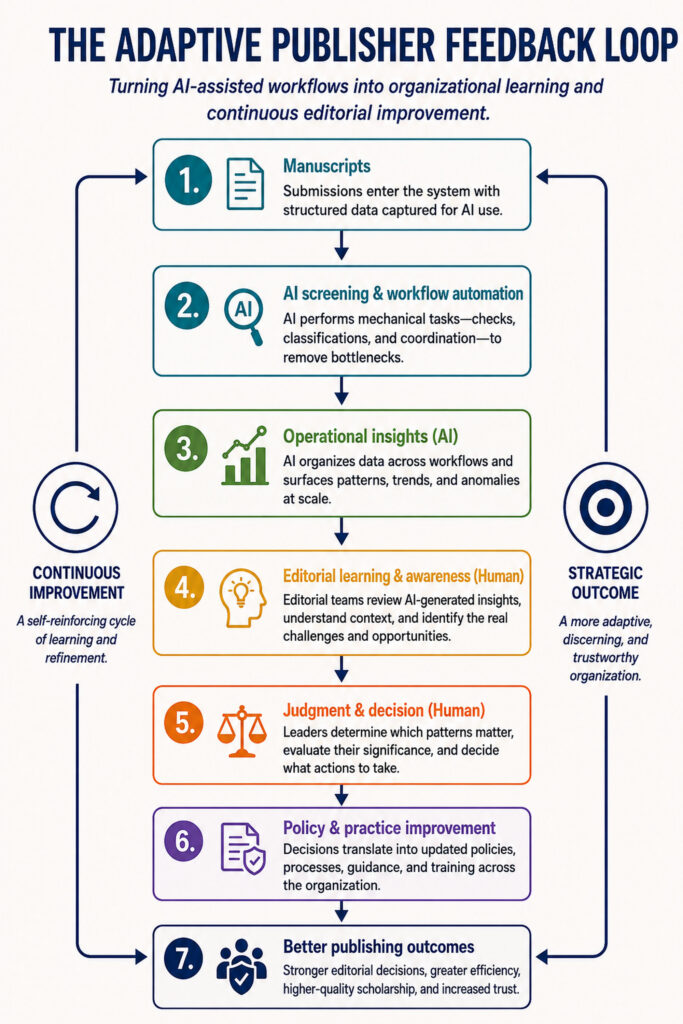
Once AI is embedded within these workflows, every manuscript, reviewer interaction, integrity investigation, editorial decision, and production activity contributes to an expanding organizational memory. AI can organize this information, maintain consistency across workflows, identify recurring patterns, and reveal relationships that would otherwise remain difficult to detect at scale. In effect, AI extends mechanical cognition at the organizational level: expanding institutional memory, strengthening operational thought, and making collective experience visible.
The question then shifts from “What does the data show?” to “What does it mean?” Patterns do not determine their own significance. AI can surface possibilities, but it cannot determine which deserve attention or action. Editorial leadership must decide which patterns represent genuine opportunities for improvement, which reflect acceptable variation, and which call for changes in editorial policy or practice. Just as intelligence governs thought within the individual, organizational discernment governs how AI-generated insights are interpreted and acted upon.
Take a publisher that discovers papers flagged by AI for methodological complexity are being desk-rejected at a disproportionately high rate. AI identifies the pattern by analyzing thousands of editorial decisions. Editorial leadership must then determine whether the pattern reflects an unintended bias, an appropriate editorial criterion, or the need to revise desk-rejection policies. Organizational learning occurs not because AI found the pattern, but because people interpreted its significance, exercised judgment, and translated that judgment into improved practice.
The most adaptive publishers will not be those that automate the greatest number of workflows, but those that deliberately combine AI’s capacity for mechanical cognition with human responsibility for discernment, judgment, and governance. A publisher that automates workflows without learning from them becomes more efficient, but not necessarily more effective. AI extends the organization’s capacity to observe, remember, and analyze, but people remain responsible for deciding what those observations mean, which actions should follow, and how the organization should learn from them. In this sense, AI becomes not simply an automation technology, but an instrument for organizational learning.
Governing Cognitive Collaboration
As AI assumes a more active role in scholarly publishing, the challenge is no longer simply how to use AI, but how to distribute cognitive responsibility between AI systems and human scholars. The Cognitive Responsibility Framework offers a practical answer: where cognition is primarily mechanical, AI can be used with appropriate oversight; where work depends on discovery, discernment, intelligence, or consequential judgment, responsibility must remain explicitly human. Mechanical cognition can increasingly be shared between humans and AI; responsibility for directing it cannot.
Patterns do not determine their own significance. People must still decide which questions are worth asking, which patterns matter, and how individuals and organizations should respond. As mechanical cognition becomes increasingly abundant, the scarce resource is no longer information processing, but the human capacity to transform knowledge into understanding through discovery, discernment, and judgment.
The enduring value of both individual expertise and adaptive publishing organizations will therefore depend on maintaining cognitive coherence: ensuring that mechanical cognition remains continuously guided by the forms of cognition that provide context, evaluate meaning, direct thought, and take responsibility for its consequences. Publishers that preserve this relationship will not simply become more efficient; they will become more adaptive, trustworthy, and resilient.
Seen through this framework, AI represents an extraordinary extension of thought, not intelligence. It expands humanity’s capacity to retrieve, organize, analyze, and generate information, but it does not replace the governing faculty that determines what is meaningful, what deserves trust, or what ought to be done. Intelligence remains indispensable not because it performs cognitive work itself, but because it governs every other form of cognition. It determines which cognitive work ought to be done, how thought should be directed, and when existing patterns must give way to discovery, discernment, and new understanding.
Scholarly publishing is the first domain where this distinction becomes impossible to ignore because it exists to evaluate, refine, and certify knowledge. The choices authors, reviewers, editors, and publishers make about which forms of cognition to delegate and which to protect will shape not only the integrity of the scholarly record, but also the broader standard by which knowledge remains trustworthy. The future of scholarly publishing will therefore be determined not by how capable artificial thought becomes, but by how deliberately we preserve cognitive coherence, prevent cognitive debt, and govern the partnership between human intelligence and artificial thought.
AI Use Disclosure: AI tools were used to assist with editing the text and to support the development of some visual concepts, which were subsequently translated into final designs by a human visual designer. The conceptualization, ideas, arguments, interpretation, storyline, and final editorial decisions are those of the author.