The last thing a graduating student wants to do before receiving his diploma is fight the system. After all, to paraphrase Mike Myers as Dr. Evil, “I didn’t spend six years in graduate school to be called ‘Mister,’ thank you very much.”
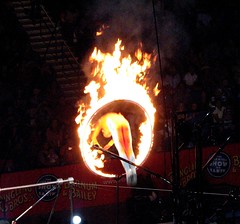
And yet the classes, teaching, research, writing, and exams were pretty tame compared to the last flaming hoops I was required to leap through in order to receive that piece of paper with my name followed by PhD.
These flaming hoops had to do with filing my dissertation — a document I’m convinced few will read with the exception of my advisory committee and perhaps my father as a cure for insomnia.
As I tried to explain to my father, who has requested several times for a document draft, dissertations are not meant to be read. They contain all of the data, in nauseating detail, a graduate student generates in pursuit of a research question, including failed experiments, supplementary analyses, data tables, and an exhaustive literature search that is designed to exhaust the reader, or at least provide some evidence that all relevant sources — however tangential — have been consulted.
In sum, dissertations are everything that a doctoral student’s professors want to see, although this does not translate into what a reader wants to read. The reader wants a couple of thousands of words, a table or two, a figure, and a nice short summary. In other words, readers want a journal article, which is exactly what I plan on spending my time writing as a postdoc. But before becoming a postdoc, I first need to become a “doc.”
And the last flaming hoop that I am required to jump through is . . . filing my dissertation.
This is where the story gets interesting. But please allow me one more short digression.
The dissertation (often called a thesis) is an old tradition that still persists in many academic fields, although many departments have replaced it with a papers option, something more contemporary with modern scientific publishing. Dissertations are public documents, and within a few weeks, two hardbound copies (printed on archival paper with gold print on their handsome black spines) will show up on our library shelves. You are welcome to read them, but you first need to get to Ithaca, NY. Alternatively, ProQuest-UMI will print and sell you a copy. But don’t bother, because a publicly-accessible file will show up in eCommons, our institutional repository, or at least this is what I’m trying to make happen. Yet, the system is working against me, providing all the wrong incentives that push me to embargo access to this file for a very long time.
On submitting my dissertation PDF, I have just two options: embargo access to the file for 5 years (the default), or make it available immediately.
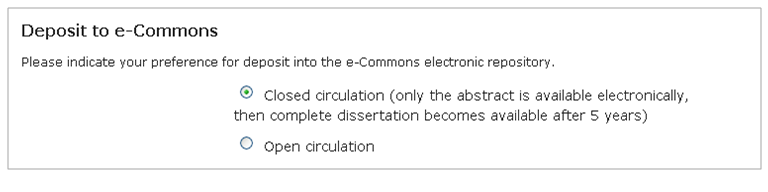
The student daring enough to change the setting to “open circulation” is then presented with a warning page with an option to go back and return the settings to the default.
It shouldn’t be surprising that the vast majority of graduate students have chosen the default. Only 11% (16 of 133) dissertations filed this year made their document immediately available, and I’ll become the 17th. While theses and dissertations belong to the largest and fastest growing collections in our institutional repository, it shouldn’t surprise you that most of these files aren’t accessible at all.
Did I tell you that Ithaca is very beautiful at this time of the year?
The ProQuest-UMI submission was a more challenging hoop. If I wanted them to make my dissertation open access, it would cost me US $160 (students have to pay UMI to index their theses and dissertations). Our Thesis Advisor even scratched out the open access checkbox on my form with a red pen and only relented to accept my decision after I convinced her that I understood the consequences. Without looking up, she handed me a payment slip and sent me off to the Bursar’s Office to pay the fee.
On the way to the Bursar’s Office, I tried to contemplate how the framers of our access policy settled on five years and why students are required to opt-out rather than opt-in to the embargo.
In my search for the answers, I discovered that many of the people involved in making this policy have either left Cornell or died. Those who remain, like the Thesis Advisor, simply continue the tradition, citing a warning that public access will dash any hope of future publication. A graduate student with any hope — even remote — of publishing after publication of his or her thesis should agree to embargo.
And yet, I could not.
I concluded that after spending a year on writing a public document, only to make it as inaccessible as possible, was antithetical to the purpose it was intended to fulfill. Indeed, consigning to lock up a dissertation on open access seemed inconsistent, if not downright hypocritical. And lastly, I have yet to find a publisher who has a hard policy against accepting a manuscript that was derived from a graduate thesis. While most serious journals have statements about only accepting original material, filing a dissertation does not seem to constitute “prior publication,” or at least none are willing to state this.
Information policy is no different from the Strange Laws of Old England that persist even when technology and social mores have changed. If universities and libraries are serious about making research publicly available, they should consider revising old policies to actively promote this goal.
Because graduate students are willing to jump through any hoop.


Discussion
16 Thoughts on "No Deposit, No Diploma: How Graduate Schools and Libraries Restrict Access to Dissertations and Theses"

Fascinating, Phil. Dissertations are a very valuable source of information about the moving frontier of science, potential collaborations, and all kinds of good stuff. Some are even meant to be read. Mine was. On the other hand they are typically mined for one’s first journal articles, as they should be if the results are at all important.
Sounds like a public policy issue to me.

There’s an old joke about an aged professor returning to his alma mater, going deep into the library’s stacks and pulling out his thesis. He opens it up in the middle, and sees the $20 bill he stuck in there when he deposited it. “Yep, still there.”
Congrats Phil.

What puzzles me is why journals aren’t clearer about their policies around theses. It seems easy to rectify, especially when there’s a chance it could clear the way for more interesting papers.
If that problem vanished, and it became widely known that it had vanished, things would change. Hear this, CSE, ICMJE, and others?

Hi Phil,
I’m writing from ProQuest. Sorry that you found the ProQuest Open Access program confusing. In short, our Open Access publishing program provides for free access to the full text from ProQuest Dissertation and Theses database (PQDT) and places your dissertation in PQDT Open (http://pqdtopen.proquest.com), which is an open website available to anyone with an internet connection. ProQuest was the first publisher in the world to provide an author pays Open Access monograph publishing option back in 2006. We think that our author pays pricing is quite reasonable compared with the fees that other author pays systems charge. When combined with placing the work in an institutional repository, ProQuest maximizes the dissemination of your dissertation to researchers accross the globe, including the 3,000 libraries that subscribe to PQDT. Last year PQDT had over 200 million searches. More people may be interested in your research than you know!

How unfortunate. When we developed our repository here at UAB a couple of years ago, it became clear early on that there were some circumstances under which a limited embargo was to the benefit of the student. But from the beginning, we assumed the default would always be openly available. The graduate school counsels students regarding those options, but the student needs to have a clear and sound reason for invoking the embargo. It’s actually in the humanities that the concerns seem more legitimate, since the “thesis” is often a publishable book. I’m not aware of anybody running into trouble publishing articles out of their dissertation research.

Sorry your institution is so limited in its conception of open access to dissertations. The institution where I work mandated an ETD (electronic theses and dissertations) program a couple of years ago, and no longer accepts print copies as a result. ETDs are deposited by the student in Proquest, and they are then made available in our IR as soon as we can get them in there. Students are able to request a maximum embargo period of 2 years, but there is no exception to the policy that they will eventually be accessible in Proquest and open-access in the IR. The majority do not request any embargo.

It seems like someone at Cornell has confused “published” with “accessible.” If Cornell prints your thesis on acid free paper with a nice gold-embossed cover and sticks it on the library shelf, it has been published. So the question of prior publication is moot. Whether it is publicly accessible electronically or embargoed is irrelevant. If a journal has a policy against prior publication, they certainly don’t distinguish between print or online publication.
In the humanities is common for post-docs to apply for fellowships with the explicit purpose of converting their (published) dissertations into (readable) books that are subsequently published by university presses. University presses don’t seem to think of dissertations as “prior publication.”
All that being said, I like the idea of having to travel to Ithaca to read your thesis. It could perhaps be set up in a special room with some Pims and a display case with your signature eye wear.
Road trip!
Cornell has a real opportunity here. Pair Phil’s dissertation with an exhibit on their other famous alumnus and they could become the Graceland of the Finger Lakes Region.

It’s important to be clear that you don’t need to pay ProQuest for your thesis to be Open Access. If you deposit it in your institutional repository with no embargo then it is openly accessible to the world.
ProQuest’s Dissertation Abstracts database is closed to anybody without a subscription or institutional access. When you pay them for Open Access, all it means is that whomever is using that database will be able to link to the full-text copy of your thesis which resides on their servers.
We advise our students not to pay the $160. We have our deposit defaults set to release the work immediately, however.
ProQuest should seriously look at the business model of Dissertation Abstracts since it is becoming obsolete. In fact, some universities are canceling their subscriptions to the database and some are no longer having their graduates send their dissertations to UMI. What’s the point if it’s made searchable and available on the web?

Unfortunately it is the policy at my institution to send theses to ProQuest-UMI and for students to pay the fee. I asked whether I could forgo this process and was told that it was not an option.
Ultimately, I decided to pay the fee to have my dissertation indexed by ProQuest but without an embargo. Strangely, this costs a lot less than making it “Open Access.” I imagine that ProQuest is banking on selling a few copies through the traditional route and thus is charging the student more for the profits they are unable to realize later on.

Phil, I think the title of this post could allow readers to believe that all universities may be following the practices of Cornell when it comes to making dissertations and theses publicly available. Our situation at Rutgers appears entirely different. At my institution, the default is immediate open access for ETDs, with a choice of optional short embargoes that authors may select. Most choose open access. Out of more than 200 authors submitting in May 2010, only 2 chose a special option of a long term embargo of 5 years. This might be a chosen option for someone in a fine arts program where issues of livelihood may be at stake. Our May graduates are seeing their ETDs already in the institutional repository at this point, and all will be available on the web by the end of September. There is no longer a print copy made available in the library, and students are not advised to pay the option for open access with ProQuest. Their work is already immediate open access and this is the option that they are choosing.
However, as a long time academic librarian, I do see value in the indexing of dissertations and theses by ProQuest. Many library users search Dissertations and Theses (ProQuest) when seeking dissertations on a subject, and I believe that the index is the basis for inclusion of some dissertations in major disciplinary subject indexes.
I mentioned dissertations as an important category of open access resources in my book “Open Access and its Practical Impact on the Work of Academic Librarians: Collection Development, Public Services and the Library and Information Science Literature(Chandos). The book is a basic treatment of the issues for the academic librarian. Certainly, dissertations represent unique institution-specific resources and would be high priority for any institutional repository.

Following up on #9: Yes, for example, the Modern Language Association International Bibliography uses the PQDT as the source for its dissertations. That is, the citations in MLAIB for dissertations are actually to Dissertation Abstracts or PQDT rather than to the dissertation itself.
PQDT is also a valuable source for graduate students to discover whether an idea they have in mind for a dissertation has already been published. Easier to do in one place, using a consistent keyword search, than to try to search in Google or in multiple IR’s.

I’m surprised that no one has mentioned the NDLTD, which is an international consortium of libraries that make dissertations available OA. I was on the committee at Penn State that set up the ETD program in 1998, and I wrote the sections on the website concerning publishing and copyright (and related sections in the FAQ), which are mostly still accurate: http://www.etd.psu.edu/. The main value of an embargo period is for students who have strong reasons to protect against full disclosure as a condition for obtaining a patent; that is a very small minority, of course. However, the discussion above does not seem to reflect awareness of library policies against purchasing books based on dissertations, which do indeed give more reason for students hoping to publish a book based on the dissertation to embargo its OA release. I deal with this in my article “Dissertations into Books?” accessible here: http://www.psupress.org/news/SandyThatchersWritings.html