Editor’s Note: Today’s post is by Jay Flynn. Jay is the Executive Vice President and General Manager of Research & Learning for Wiley.
After three decades in STM publishing, I’ve been on the frontlines of some big industry transformations, but I think we’re in the midst of the most dramatic change yet. At conferences and in meetings today, the energy feels similar to the moment in the mid-90s when we first moved to the web. The difference is that this time, AI is presenting new challenges while also giving us tools to innovate in ways we couldn’t have imagined even five years ago.
Here’s the other thing I’ve learned over the last 30 years: the most successful publishers are those willing to challenge the status quo. Today, the tools and market conditions are lining up and creating a moment for publishers to start thinking bigger and making moves that, if we’re honest with ourselves, are a little overdue.

Why Now
STM publishing was one of the first to the web, and we figured out how to make money online when other industries were still giving content away for free. We said, “content has value,” and people kept paying for it. But along the way, we got so good at protecting what we had that we stopped innovating. Over the last few decades, from an end-user perspective, publishing technology (especially the back end) basically sat and watched as a generation’s worth of innovation happened all around it.
Now we need to rediscover and channel that same 90’s pioneering energy into the AI era. Only this time, we have the advantage of learning from three decades of digital transformation. Instead of playing catch up, we’re positioned to lead in an environment where AI is fundamentally changing how people create and discover knowledge. While library budgets are still tight, and the administrative side of open access needs some serious optimization, these challenges are also the conditions for the kind of innovation that creates competitive advantage.
Looking around at everything happening in the world right now, whether it’s AI transformation, the critical need for trusted information, or shifting global research dynamics, publishers have never been more essential. It’s time to innovate again in a big way to grow the value and impact of what we do.
Three Moves
There are three things that I’d argue almost any STM publisher could start doing (or start doing more of) that will unlock more value in the research publishing ecosystem.
1. Globalize Your Portfolio
The globalization of research is one of publishing’s greatest but maybe most under-appreciated opportunities: a globally diverse portfolio is a natural buffer as research funding and output inevitably shifts. For example, if you’re following U.S. politics at all these days, you’ll know that U.S. research and education is under pressure. While the ultimate impact on things like total publication output are hard to predict, it’s also important to remember that the U.S. hasn’t been a huge contributor to global research growth for a while now. Looking at National Science Foundation data on global article output from 2003 to 2022, articles from countries like the U.S. and Germany essentially stayed flat, while output from China and the rest of the world grew dramatically.
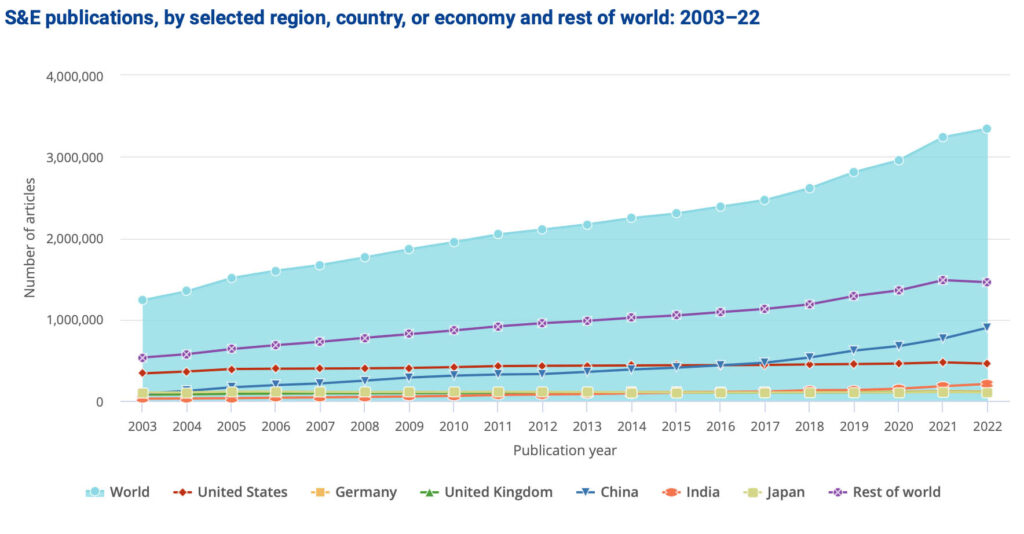
Output alone of course doesn’t translate to research impact, but as a recent report from Clarivate shows, authored and co-authored papers from China are growing in citation impact while collaborative papers in general are also cited more frequently than domestic papers.
Bottom line, research is global, and our portfolios and editorial boards should reflect that reality. Global diversity makes for better science and better business. A more global portfolio and global representation across our editors, authors, and reviewers not only mitigates risk, it reflects the reality that knowledge creation is happening all over the world.
2. Modernize Your Technology
An obvious one, but has to be said: Modernize your tech. Publishing infrastructure has lagged behind for years, anchored to PDFs, legacy library formats, and procurement models that penalize the first mover.
AI changes the equation. Instead of catching up incrementally, publishers can now redefine the digital experience for researchers, reviewers, and readers. The real opportunity is not in digitizing old workflows, but in using AI to reimagine how knowledge can be created, validated, and connected.
Modern platforms should serve as engines of trust and efficiency, automating what machines do best while freeing humans to focus on judgment and insight. They should also prepare content for the next frontier of discovery, ensuring that research outputs can be read and reasoned over by both people and AI. As others here in The Scholarly Kitchen have written, if your content can’t be discovered through AI agent search, you’re invisible to a growing portion of users.
At Wiley, we’re designing the next generation of publishing platforms, AI-powered, author-centric, and built to elevate speed, integrity, and trust across research. And because progress in research depends on collaboration, we’re making this technology available to partners across the industry.
Wiley’s latest research shows that 62% of researchers now use AI for research and publishing related tasks, up from 45% in 2024. Interestingly, 80% use general-purpose chatbots compared to just 25% using specialized AI research tools. Which brings us to number 3: lean into AI.
3. Shape the AI Future, Don’t Be Shaped by It
As AI becomes woven into every stage of research and communication, publishers have a decisive role in shaping how it’s used.
We have a responsibility to shape how AI learns from, applies, and distributes trusted knowledge. Practically, that means licensing content responsibly, setting clear ethical standards for its use, and building open technical frameworks that connect high-quality research to the tools people rely on.
It is our responsibility to ensure that AI tools surface research over rumor, elevate evidence over opinion, and champion credibility over confusion, so that trusted knowledge lights the way in an age of misinformation.
The Choice Ahead
The real question then isn’t whether publishers can adapt to change, it’s whether we’ll move decisively enough to lead it.
We have the opportunity to draw on the world’s most trusted content, the communities that create and fund it, and technologies that barely existed five years ago.
If we link the best scholarly content with intelligent technology, if we collaborate effectively with researchers, societies, publishers, and libraries, we can build a research ecosystem defined by trust, transparency, and impact.
Discussion
1 Thought on "Guest Post — Three Ways to Innovate and Reimagine Publisher Value in an AI World"

> this time, we have the advantage of learning from three decades of digital transformation
^ I think this is key. From our vantage point now we should have a clear understanding of the lifecycle of how new technology is adopted (faster Y cheaper -> better -> different) and the behavioural change journey along the way.
One differentiator though is the pace of change in the AI landscape. At least currently we’re seeing step changes in foundational models every 3-4 months. From a modernizing publishing tech perspective this has to mean building in flexibility as a foundational design principle.