Scholarly communications faces a complex landscape as policy, technology, and public expectations reshape how research is created, communicated, and trusted. This report examines how organizations across the scholarly communications ecosystem view advocacy, align on industry priorities, and address the challenges of engaging with policymakers and the public.
This Pulse Check Poll was distributed to members of the Society for Scholarly Publishing, readers of The Scholarly Kitchen, and other professionals in the scholarly communications community. There were 186 respondents from a variety of organization types, sizes, and job levels.
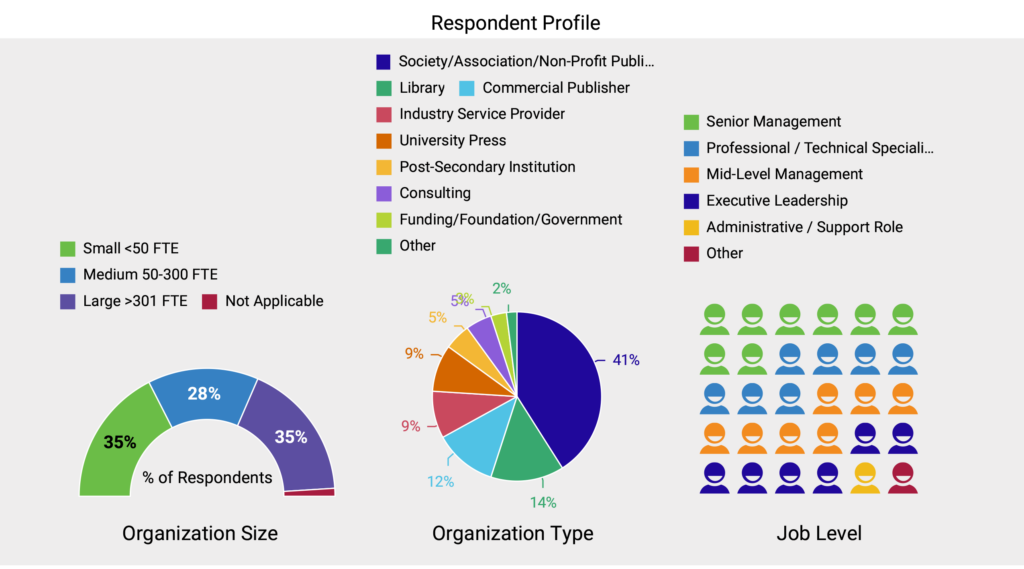
This post provides high-level aggregate results; the full report, available at no cost on SSP’s website (log-in or account creation required), provides additional detail and the ability to filter the data by organization size, type, and job level of respondents.
Key Findings
- Across the community, there is a clear consensus that coordinated engagement is most critical where policy decisions shape the research and publishing environment.
- Research integrity, funding and infrastructure, sustainable business models, and the ethical use of AI form a tightly connected core of concerns, reflecting both long-standing pressures and rapidly evolving risks.
- Participation in coalitions, policy monitoring, and direct engagement is widespread, indicating that advocacy is active across the ecosystem, even if approaches differ.
- A lack of staff time and resources far outweighs all other constraints, suggesting that organizations are motivated but need more scalable ways to participate.
- Organizations are asking for centralized data, practical toolkits, and coordinated campaigns — resources that reduce duplication and enable more consistent, collective action.
A Collective Voice
Looking at the aggregate responses, there is a strong consensus around engaging policymakers with a collective voice, which receives the highest weighted average (3.65) on a scale where 4 is critically important, and 1 is low importance. This stands out as a clear priority, indicating broad alignment that coordinated messaging is most critical where policy decisions directly shape the research publishing environment.
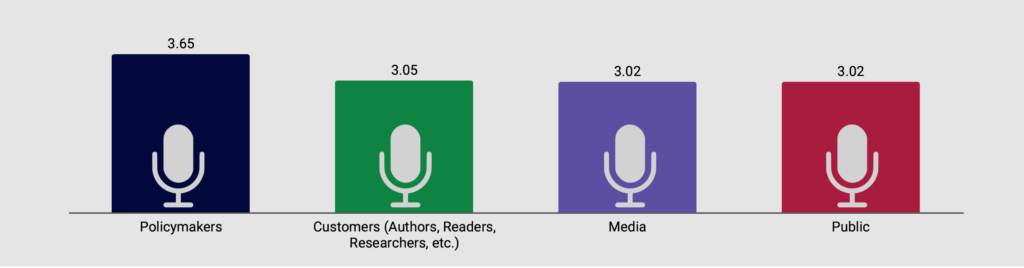
Coordinated engagement with customers (authors, researchers, readers, etc.), media, and the public is viewed as important (3.02-3.05), but notably lower than that of policymakers. This points to a recognition of their influence on perception and trust, and that alignment matters. However, there may be more comfort with differentiated or organization-specific approaches when communicating with core scholarly stakeholders.
Mission Critical Priorities
When it comes to policy and advocacy themes most critical to an organization’s mission at this moment, there is a clear focus on a core set of interrelated priorities, with research integrity and quality (46%) emerging as the top concern. This is closely followed by research funding, infrastructure, and institutional support (41%) and sustainable funding and revenue models (40%), indicating strong alignment around both the credibility of the scholarly record and the systems that support it. Ethical and responsible use of AI (40%) also ranks among the top tier, reflecting how quickly AI-related considerations have become central to the community’s policy landscape.
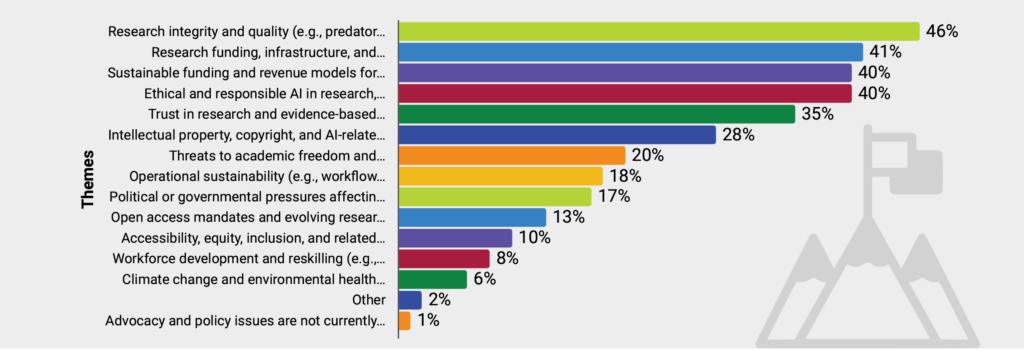
A second tier of priorities includes trust in research and evidence-based knowledge (35%) and intellectual property and copyright (28%), reinforcing the connection between integrity, access, and long-term stewardship. Overall, the results point to a community focused on protecting the integrity, sustainability, and trustworthiness of research systems, particularly as they intersect with funding realities and rapid technological change.
Current Efforts
The most common advocacy activity among organizations is participating in industry coalitions and alliances (59%), followed closely by monitoring policy and regulatory developments (52%). Active engagement strategies, such as direct meetings with policymakers (42%), public communications (41%), and educational events (37%), are also widely used, suggesting organizations favor both awareness-building and direct influence.
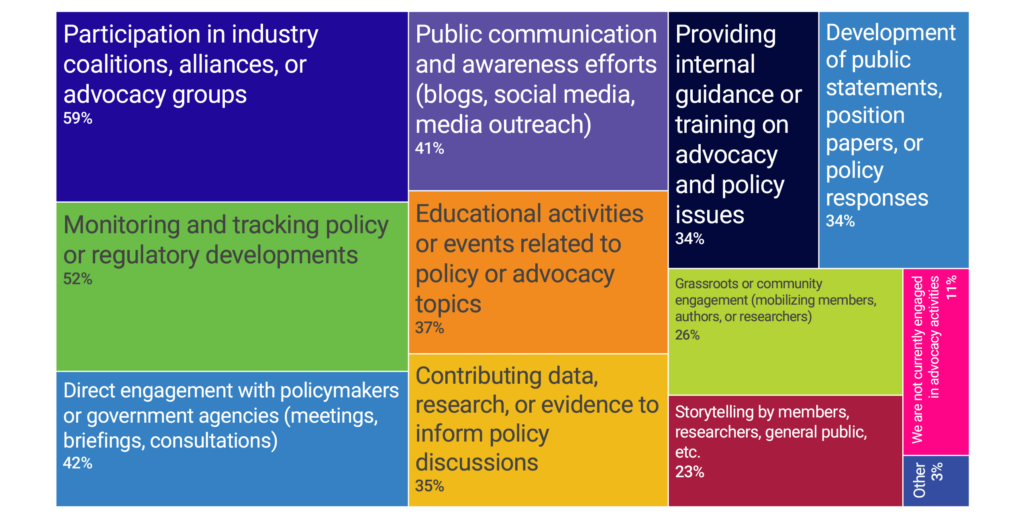
Evidence-based approaches like contributing research (35%) and developing position papers (34%) are similarly common, reflecting an emphasis on credibility-driven advocacy. Internal capacity-building activities, such as training staff on policy issues (34%), round out the mid-tier responses.
Less common are grassroots and community engagement tactics — mobilizing members or researchers (26%) and storytelling (23%) — indicating these participatory approaches are still underdeveloped in many organizations.
Engagement Barriers
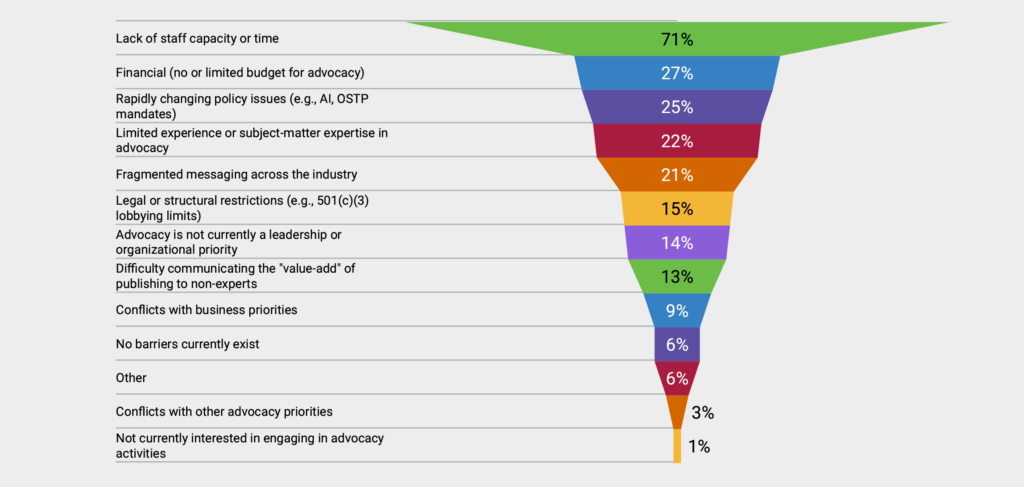
The top barrier, by a wide margin, is a lack of staff capacity or time, cited by 71% of respondents. This dwarfs every other barrier and signals that the core challenge is fundamentally a resource and bandwidth issue, not a lack of interest or awareness.
The next tier of barriers clusters in the 20-27% range: financial constraints (27%), rapidly changing policy issues such as AI and OSTP mandates (25%), limited experience or subject-matter expertise in advocacy (22%), and fragmented messaging across the industry (21%). Together, these suggest that even organizations willing to engage more deeply face a combination of budget limitations, a fast-moving landscape, and uncertainty about how to advocate effectively.
Resource Needs
The most sought-after resources are centralized industry data and research to support policy goals (58%) and advocacy toolkits, including templates, talking points, and messaging frameworks (56%). These two top-ranked responses are closely aligned and together suggest that organizations feel they lack both the evidence base and the practical tools needed to advocate confidently and consistently.
Joint public awareness campaigns coordinated by industry organizations (45%) rank third, reinforcing the theme seen throughout earlier questions. That is to say, a large contingent of the industry sees real value in collective, coordinated action rather than going it alone.
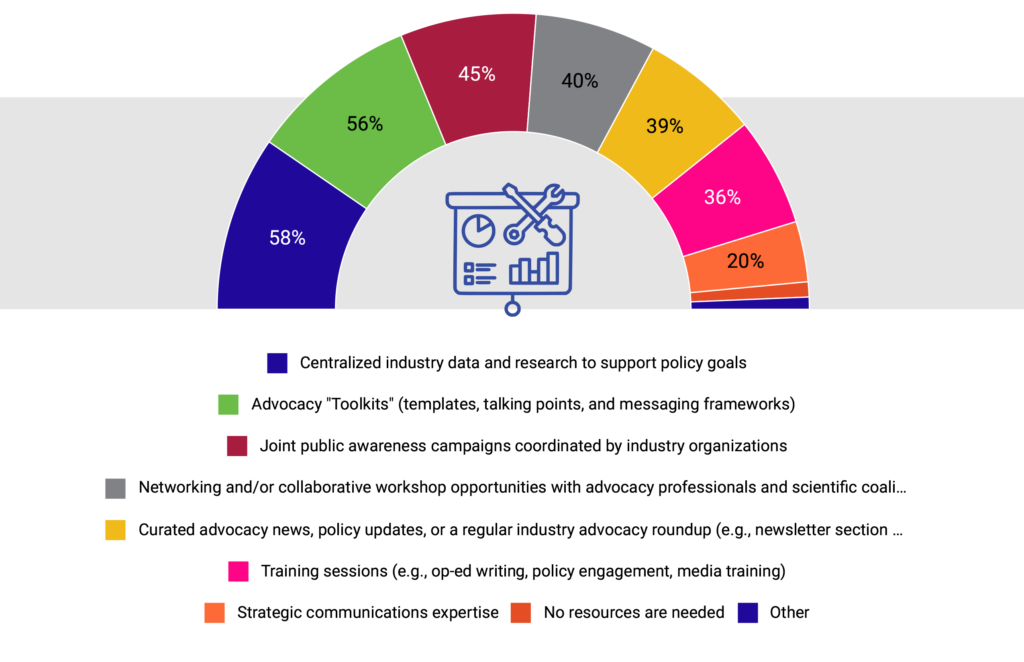
Networking and collaborative workshop opportunities with advocacy professionals and scientific coalitions (40%) and a curated advocacy news or policy roundup (39%) cluster closely together in the mid-range, pointing to demand for both community connection and staying informed without having to do all the monitoring themselves.
Training sessions covering op-ed writing, policy engagement, and media training were cited by 36%, indicating meaningful interest in building internal skills; however, it ranks lower than ready-made tools and shared resources. Notably, very few (5%) respondents indicated that no resources are needed.
Opportunities for a Unified Voice
Only about a third of respondents offered their thoughts on where the scholarly publishing community is most likely to gain meaningful traction through coordinated advocacy in the next 12 months. These open-ended responses can be classified into five overall themes.
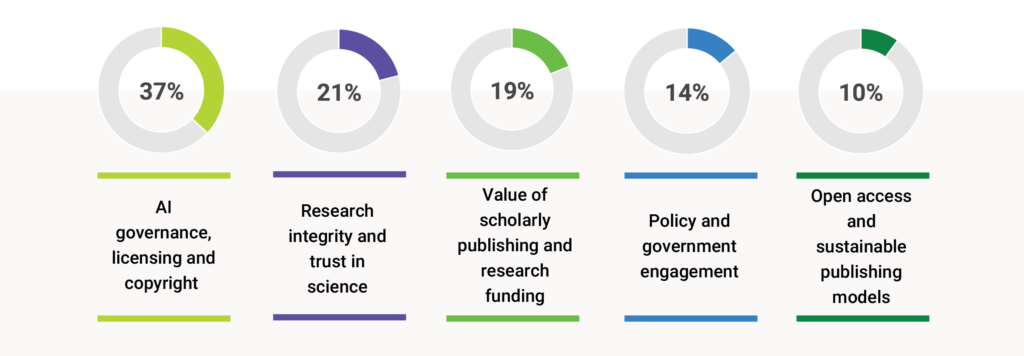
AI governance, licensing, and copyright
AI licensing frameworks, copyright protections for publisher- and author-owned content, ethical/responsible AI use standards, policies on undisclosed AI use in manuscripts, and a unified stance against “AI slop.” Several framed this as an urgent, narrow window to shape policymakers before norms calcify.
Research integrity and trust in science
Strong concern about eroding public trust in science, the spread of misinformation, paper mills, predatory journals, and compromised peer review. Several called for cross-industry standards and coordinated publisher action on retractions, corrections, and research integrity infrastructure.
Value of scholarly publishing and research funding
Respondents want the community to articulate the public good of scholarly publishing to policymakers, funders, and the public. This includes defending research budgets, demonstrating the economic ROI of R&D, countering anti-science narratives from the current US administration, and positioning scholarly publishing as critical knowledge infrastructure.
Policy and government engagement
Direct lobbying, congressional briefings, letter-writing campaigns, and engagement with policymakers who support science. Mentions of the court system, EU/UK governments as more receptive venues, and opposing censorship or federally mandated publication restrictions. Several called for action specifically around the current US administration’s defunding of research and scholarly infrastructure.
Open access and sustainable publishing models
Calls for sustainable OA funding (especially diamond OA and nonprofit infrastructure), pushback against APC caps, and finding common ground between commercial and mission-driven publishers. A few cautioned against prioritizing OA over more urgent crises.
Additionally, several respondents expressed skepticism that a “unified voice” is achievable or desirable, given the divergent interests of commercial vs. nonprofit publishers, or publishers vs. libraries. A subset essentially said the US is not a productive venue right now and pointed to EU/UK policymakers as more receptive. There was a recognition that we may need to set aside divisive issues to focus on areas of consensus.
Conclusion
The survey reveals a community motivated to advocate collectively but constrained by capacity limitations, fragmentation, and a rapidly shifting policy environment. Policymaker engagement is the clearest shared priority, and AI governance has emerged as an urgent, time-sensitive opportunity. At the same time, research integrity remains the community’s most universally held concern. Organizations of all sizes cite staff capacity as the primary obstacle to deeper engagement, pointing to strong demand for shared tools, centralized data, and coordinated campaigns that reduce the burden on individual organizations. Together, the findings suggest that the highest-value near-term investment is building collective infrastructure around a focused, achievable agenda anchored in AI governance, research integrity, and the defense of research funding.
The full report, available at no cost on SSP’s website (log-in or account creation required), provides additional detail and the ability to filter the data by organization size, type, and job level of respondents. If you have a suggestion for future Pulse Check Polls, send your ideas to info@sspnet.org.
Author’s note: Data was collected April 1–20, 2026. AI applications were used to assist in the analysis and summarization of the data in this report.

Discussion
2 Thoughts on "Shaping Our Collective Voice Through Advocacy — SSP Pulse Check Report"

Thanks, Melanie, for this very comprehensive and timely article. It strongly reflects the community’s voice and shared concerns. The issue of capacity and dedicated focus stands out as the primary challenge, and one way to address this could be through an industry expert volunteer-based task force that identifies key issues, compiles research and data, and engages policymakers more directly on transformation and advocacy, while also exploring these challenges in greater depth and coming up with new solutions. Organizations like Committee on Publication Ethics could serve as a useful model for such an initiative.

I think the key finding here is the contradiction between the publishers (largely non-profit/society publishers) stating that working with policy makers is a priority while simultaneously stating that they don’t have time/money for that priority. As someone who tried to put together a policy group of publishers to have influence with the US government, I can tell you that our industry as a whole seems to only be motivated by crises. When there are existential threats coming from government, everyone steps up, but then when those are resolved, no one has the time or money to bother.
And this is why we are so poorly served by governmental policy. Government relations are not things one can turn on and off, they’re about building long term relationships and trust. Because those nonprofits only jump into the arena when there’s a fire to be put out, those relationships are never created. It’s perhaps indicative of the lack of trust of the US government toward our community that we are repeatedly caught surprised by new policy announcements (e.g., Droegemeier OA policy, Nelson Memo, etc.) rather than being part of the discussions when those policies are being formed.
The only parts of our community with consistent representation in Washington are the large, commercial organizations, largely through trade groups, and what they want may not be what the nonprofit members of the community want. But unless we are willing to step up, invest the time and money necessary, we will continue to get what we get and not have a seat at the table.