Editor’s note: Today’s post is by guest bloggers Lou Peck and Andrew Smith. Lou is the Chief Executive Officer and Founder of the International Bunch, and she is passionate about accessibility, marketing, and community engagement. Andrew is the Global Product & Marketing Director at Charlestworth, an Enago company, where he leads the company’s global marketing agency and product development teams.
Authors’ note: The audio file linked below provides a spoken version of this blog post.
As global priorities shift and the world feels smaller yet more complex, one thing has become clear: being visible is not the same as being relevant. Real international success is not about scaling what works at home, but learning how to resonate elsewhere. As Abhi Arun said in his “Midnight At The Casablanca” podcast, “What is considered ethical in one part of the world is not exactly the same in another part of the world.” To succeed, marketing needs genuine localization, adapting tone, channels, and strategy to connect with what really matters in each community we support.
Did you know that 65% of people will not engage with content that is not in their own language? But language is just the start. Localization is about cultural fluency: the context, humor, colors, and tone that make something feel authentic. Translation is transactional; localization is transformational. This is not just about our external communities, but our internal team communities.

Beyond Translation: What Resonance Really Means
In the research ecosystem, small cultural missteps can have big consequences. What feels creative or neutral in one region can miss the mark completely in another. Even large organizations have learned this the hard way. HSBC’s early 2000s tagline, “Assume Nothing,” was mistranslated around the world as “Do Nothing.” The fix was a US$10 million global rebrand that led to its much more fitting message: “The world’s local bank.”
Publishing has its own version of this challenge. Direct machine translation of key terms has produced equally awkward outcomes, such as “open access” appearing in Mandarin as “unlocked entry,” or “peer review” translated into Spanish as “review by friends.” Funny…but it highlights a serious truth: meaning gets lost when we do not localize for both language and context. Especially challenging when many AI tools work better in English at the moment than in other languages, human oversight remains critical.
True localization takes courage. Adapt your message, loosen control, and sometimes rewrite what “good” looks like.
The Tea Test: Why Localization Matters
Thinking about how culture shapes perception, just look at how people make tea.
In the UK, tea is practically a national ritual. The British Standards Institution (BSI) even formalized it in BS 6008:1980 (superseded by ISO 3103:2019), a technical specification of the “correct” way to brew tea for sensory testing: boil the water, warm the pot, steep for four to five minutes, then add milk.
In the US, things look very different. Viral videos of Americans microwaving cold water and dunking a teabag have caused near-diplomatic incidents online. What feels normal in one culture can feel completely wrong in another.
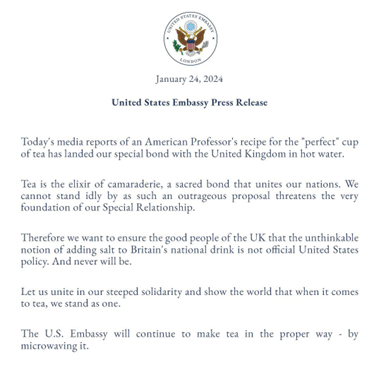
That point was made rather literally in January 2024, when American chemist Michelle Francl suggested in her book Steeped: The Chemistry of Tea, for the Royal Society of Chemistry, that adding a pinch of salt can reduce bitterness. The idea sparked a light-hearted storm. The U.S. Embassy in London quickly issued a statement clarifying that salted tea was “not official United States policy.” The playful “brew-haha” made headlines and showed how deeply identity can creep into the smallest rituals.
In China, the birthplace of tea itself, tea is not just a drink but a symbol of history, respect, and connection. The preparation, serving, and even the words around tea differ across regions and generations. The simple act of offering tea can convey hospitality, gratitude, or a sense of peace.
It is a fitting reminder that even something as universal as tea is not one-size-fits-all. The same applies to communication, marketing, and publishing. What works in one culture must be reinterpreted to resonate in another.
The Power of Localization is Essential
We have certainly seen geopolitical shifts. For example, in the US, organizations that have focused heavily on their core US market are now looking to improve their international approach outside North America. While maintaining their strong and integral relationships with US Funders, CHORUS has increasingly been bringing more funders into the conversation. Notably, their continued international collaboration with the Japan Science and Technology Agency (JST) includes joint forums at Japan Library Fair 2025 and JOSS 2025 featuring speakers from Japan and the US. The Republic of Korea joined Horizon Europe as the first Asian country in 2025, with Korean entities able to be beneficiaries of Pillar II with its €52.4 billion fund. Korean researchers now have access on equal terms, focusing on shared global challenges including climate, energy, digital economy, and health. There are many more opportunities for international collaboration and strategic change.
If you are not present, researchers and users still are. A bad experience, fake news, or a misunderstanding can all fester and hurt your organization, publishing, or journal brand. You need to better understand that and what to do next.
According to The Charlesworth Group’s 2025 whitepaper, Author Marketing in China, the world’s largest community of STM authors produces over 20% of global scientific publications. One-third of China’s high-impact research involved collaboration with countries across the world, but challenges remain familiar: long review times, high publication fees, peer-review bias, and unfriendly submission systems. For early career researchers and postgraduates, these barriers are particularly tough.
The authors told Charlesworth they want more than translated instructions; fair, human, and transparent engagement; and publishers who understand their reality. English as a second language (ESL) authors can write in English, but it may take them time to read and process the language. Of course, they can understand English marketing, but engagement will be lower. Reduce the friction through localization of both language and channels by being present where they already are:
- WeChat for professional updates and mini-program submissions
- Bilibili and Douyin (TikTok) for learning and community
- Zhihu for trusted peer discussion and Q&A
- Baidu and RedNote for journal discovery
Engaging across these local channels can lead to up to 40% higher submission intent among early career researchers compared with single-channel approaches. That is a powerful reminder that digital ecosystems are not universal; they are regional.
Strategy, Not Afterthought
If you want to succeed in other markets and build a sizeable share of articles — and marketshare more broadly — you need to adopt the same mindset and treat the market as one of your strategic and primary priorities:
- Have a region as a top-level corporate SMART objective that translates into your departmental objectives to ensure alignment and focus. Start with markets where data shows the biggest opportunities, e.g., China, India, Japan, Latin America, and other regions with dynamic research growth.
- Think about how you demonstrate impact. ISI Impact Factors (ISI IF) will do some of the marketing for you in markets like China. But in contrast, Australia’s Excellence in Research for Australia (ERA) system has decisively reduced the role of ISI IFs, shifting towards peer review, qualitative assessment, and broader impact measures. And, as many are DORA signatories, consider “impact” for your regional target, with additional metrics such as CiteScore, altmetrics, societal impact, etc.
- Not being present is allowing your competitor to build a brand and a localized experience. Where are your competitors engaging with your communities? If your key journals are receiving high numbers of submissions, is your wider list performing, and are you getting the quality of output? Are these submissions the ones you want? Do not look at the big number; look at the relevant number.
- Local competitors who understand the market better than international ones offer a fully regional experience, local workflow and support, and greater impact in the long term. It takes time to build a brand, heritage, and the reputation of international organizations. Ensure this is front and center in key markets.
- Listen before acting, ask what matters most to different communities, and build from there. Ensure you get feedback so people feel like they are part of making change happen. Simply saying, “thank you for participating in a survey and these were the outcomes,” can go a long way for retention and avoiding survey fatigue.
- Be inspired by lessons learned and shared industry insights, like India Rising: How Society Publishers can Prepare for the Incoming Surge in Quality Submissions.
Localization is not something to tack on at the end; it is a mindset. It starts with curiosity and empathy. You can not localize everywhere at once. Technology is changing what localization can do. AI boosts efficiency, but machine translation often misses cultural and emotional tone. That is why effective localization blends both worlds: AI for speed and scale, people for empathy and precision. That is especially true in scholarly communication, where connection and credibility are everything.
At its heart, localization builds trust. Communicating and supporting your stakeholder groups in their own language is when trust takes root. Localization creates real global impact. Focus where it matters most, learn and partner with local experts, and build from a place of empathy – people sell to people, not companies to people.
Because in the end, international success does not come from being seen everywhere, it comes from mattering somewhere.


Discussion
2 Thoughts on "Guest Post — What is The ‘Right’ Way to Make Tea? Why International Marketing Needs a Local Touch"

Lou – absolutely love the audio version – thank you 🙂

Any time! My three latest posts I co-author have audio 🙂