Today’s guest post is by Liz Martin, Head of Content & Production for IOP Publishing.
At IOP Publishing (IOPP), sustainability shapes the way we operate and the goals we set for the future. Over the past five years, Liz Martin, Sustainability Lead at IOP Publishing (IOPP), has been leading efforts to reduce the organisation’s carbon emissions. In this post, Liz shares insights into IOPP’s sustainability journey, how they got started, and the results that show what’s possible when sustainability is embedded into purpose-led business decisions.

Understanding Our Environmental Impact
We’ve long been conscious of our sustainability impact and making changes to reduce it. In 2019, we set out to firm up the actions needed, with the first task sounding so simple: work out the true size and shape of our carbon footprint — you can’t cut what you can’t count, right? As the first step, we mapped our operational data to really understand the environmental implications of our business and identify the areas where change could have the greatest effect.
Partnering with ClimatePartner gave us the frameworks and support needed to baseline our carbon emissions. Carbon footprinting is simple in theory, but can be complex in practice; you need to set clear boundaries on what you are measuring, make decisions on how you are calculating emissions, and you need to have a lot of operational data. Much of the data is simple to track in real time, but difficult to gather retrospectively.
Five Years of Measuring, Learning, and Improving
That first carbon footprint calculation in 2020 was challenging; it took a long time and sometimes felt like trying to roll a boulder up a hill, but we got there and learnt so much along the way. So much so that the second footprint calculation the year after was a breeze in comparison. By then, we had better methods, more primary data, and far greater accuracy. In fact, we had improved so much that we recalculated the previous year too, making 2020 our accurate baseline for measuring progress going forward.
We continue to improve our data collection and use of primary data, but even from that first calculation, we were able to identify our hotspots, areas of business activity that generated the most emissions, and therefore those that would deliver the business a positive impact if addressed. With this insight, we could begin focusing on the changes that would make the biggest difference, targeting actions that would deliver reductions in our overall carbon footprint.
The Results
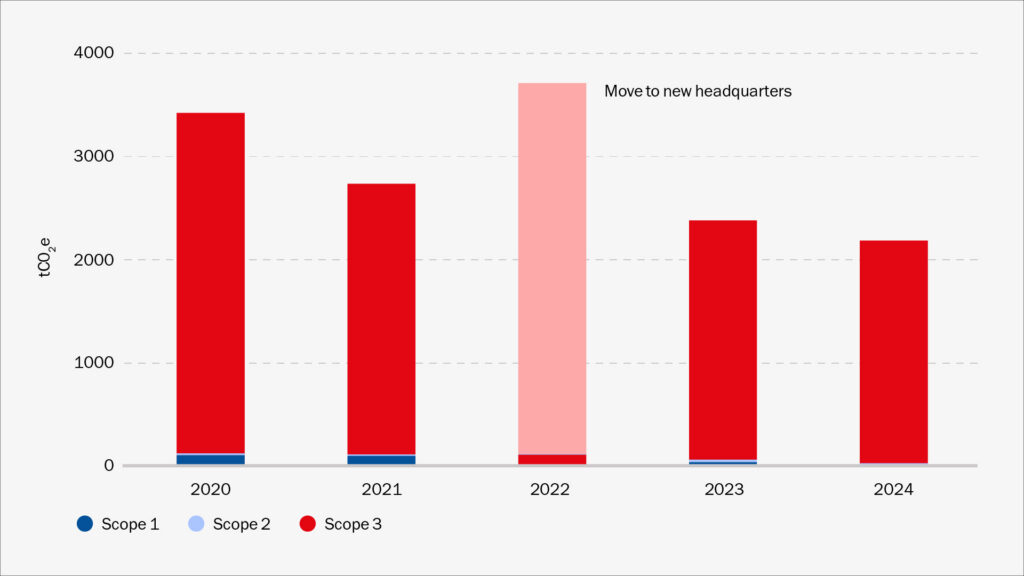
Five years on, we are now able to report that we have reduced our carbon emissions by 36% compared to 2020. You can find out more in our first online sustainability report.
Our carbon reductions have been driven by strategic decisions and the following standout actions:
- A new low-impact headquarters: Although our move to The Distillery in Bristol in 2022 briefly increased our emissions while two sites operated in parallel, the long-term benefit has been substantial. The new building is designed with efficiency in mind and has reduced energy consumption, as well as enabling us to operate more efficiently on a day-to-day basis.
- A digital-first publishing model: While we already operated a digital-first model across all our products, like many, we continued to have some print offerings. Discontinuing print subscriptions for our journals and developing the digital version of Physics World, the membership magazine of the Institute of Physics, has allowed us to massively reduce carbon-intensive print production and physical distribution. While this does not eliminate emissions from publication completely, we are committed to fully understanding the impacts of our digital products and participate in the DIMPACT project to support the industry more widely.
- Supply-chain engagement: Not all of the emissions associated with our business are fully within our control, so engaging our supply chain is essential. We work closely with suppliers to encourage more sustainable practices and greater transparency in their reporting. As a result, we’re seeing increasing commitment to environmentally responsible operations, with many suppliers now embarking on or accelerating their own sustainability journeys.
- Sustainable travel guidelines: We have woven the environmental considerations of business travel and employee commuting into our colleague guidelines. This ensures everyone has the information they need to make good choices, not just about how they travel, but also about when to travel and how often.
The Challenge and Opportunity of Scope 3 Emissions
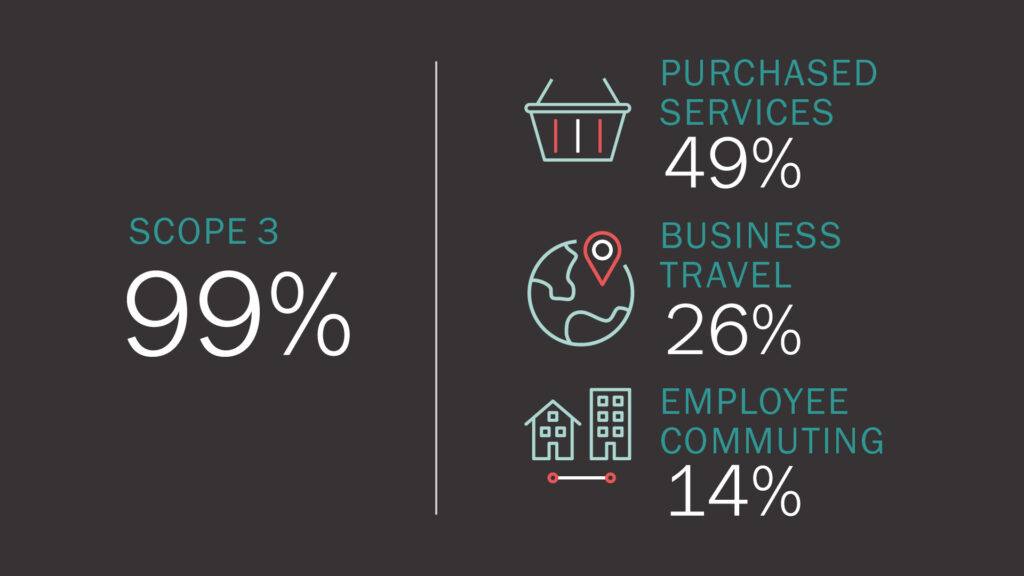
By 2024, 99% of our emissions came from Scope 3 sources. This category includes purchased goods and services, business travel, and employee commuting. These three areas alone make up almost 90% of our total footprint, so they are a key priority for us. They are also the toughest to influence, as they can sometimes come into conflict with business growth. We don’t have all the answers yet, but we are embedding environmental considerations into decision‑making across the business. This is where the biggest gains can be made. We also proactively engage suppliers to share their environmental activities and commit to greener practices. This approach allows us to encourage change across the broader publishing ecosystem, creating a ripple effect far beyond our immediate operations.
Empowering Colleagues to Take Action
Internal engagement has become another powerful driver of change. Sustainability can’t simply live in a strategy document. It requires everyday action from everyone across our organisation. Over the past few years, we have worked hard to take our colleagues with us on our sustainability journey by:
- Hosting talks with influential environmental voices, including Laura Young (Waste Less Laura), Professor Mark Maslin, and Jojo Mehta of Stop Ecocide International.
- Encouraged staff to adopt more sustainable commuting and travel habits.
- Rolled out Giki Zero, giving colleagues access to a tool to measure and reduce their personal carbon footprints.
- Participated in global sustainability challenges like the Employee Race to Zero, where IOPP staff placed 9th by completing 202 steps and contributing to the avoidance of nearly 34 tonnes of CO₂ emissions across all participants.
- Actively encourage the minimization of the use of resources and recycling across all our offices.
The result has been an increase in personal and collective climate awareness and a culture where sustainability is practised, not just promoted.
Publishing That Supports Global Change
Our sustainability efforts are not only about reducing our own emissions. As an academic society publisher, we also play an important role in advancing research that addresses environmental challenges. We publish environmental science that deepens understanding, informs better policy, and provides solutions to issues such as climate change, biodiversity loss and resource scarcity.
Crucially, we believe this knowledge should reach as many people as possible, wherever they are in the world. As a signatory of the UN Sustainable Development Goals (SDG) Publishers Compact, we are committed to widening access to high‑quality scientific research and aligning our work with the goals of sustainable development. This commitment comes to life through several major initiatives, including:
1. The Sustainability Collection
We bring over 11,000 SDG-related open-access articles together into a central place in our SDG Collection. Our collection can be navigated with an intuitive search functionality that filters by SDG and by year. These articles have been downloaded 6.7 million times in the past years. Each download represents someone, somewhere, using trusted research to drive positive change.
2. The Environmental Research Series
We’ve also expanded our portfolio of environmental research journals. What began as a single journal has now grown into a multidisciplinary collection of open access titles covering climate, ecology, energy, food systems, environmental health, infrastructure and water. These journals create a collaborative space where researchers from different fields can connect and share new insights.
3. Sustainability Science and Technology
The most recent addition, the journal Sustainability Science and Technology, brings together engineering, chemistry, physics, materials science and environmental science to tackle sustainability challenges that don’t fit neatly into one discipline. Because real-world problems are interconnected, research solutions must be too.
Looking Ahead with Optimism
As a sustainability lead for IOP Publishing, I’ve come to appreciate just how complex it is to understand and manage our environmental footprint. The past five years have shown me that publishers can play an important role in shaping a more sustainable future. Not only through the way we operate, but through the research we help bring into the world.
I’m proud of the progress we’ve made, but there’s still a great deal more we can do. Strengthening our supply-chain partnerships, engaging colleagues and amplifying the impact of environmental research we publish will continue to be our focus in the years ahead. But our progress so far proves what’s possible when sustainability is embedded into our business decisions.
For me, sustainability goes well beyond carbon metrics or the launch of new journals. For me, it’s about the legacy we leave for future generations and supporting the scientific community. We all have a role to play: researchers, publishers, policymakers and suppliers alike.
And if you’re at the beginning of your own carbon reduction journey and simply want to talk about how to get started, I’m always open to a conversation. Just leave a message in the comments section below.