
- Image via Wikipedia

Last Thursday evening, December 10, 2009, the Office of Science & Technology Policy opened a Policy Forum on Public Access to Federally Funded Research: Implementation, a public site providing “the public and various stakeholders” an open forum for the discussion of implementing broad national policies on access to the results of federally funded scientific research. The question posed was not “if” but “how” policies would be implemented.
“To what extent and under what circumstances should such research articles—funded by taxpayers but with value added by scholarly publishers—be made freely available on the Internet?”
For an open 10-day period, the OSTP wants comments on important details for implementation, such as
- Who should be responsible for making the decisions?
- What is an adequate period of delay for access?
- Which version(s) should be made available?
- Should the policy be voluntary or mandatory?
What the OSTP wants are details not diatribes.
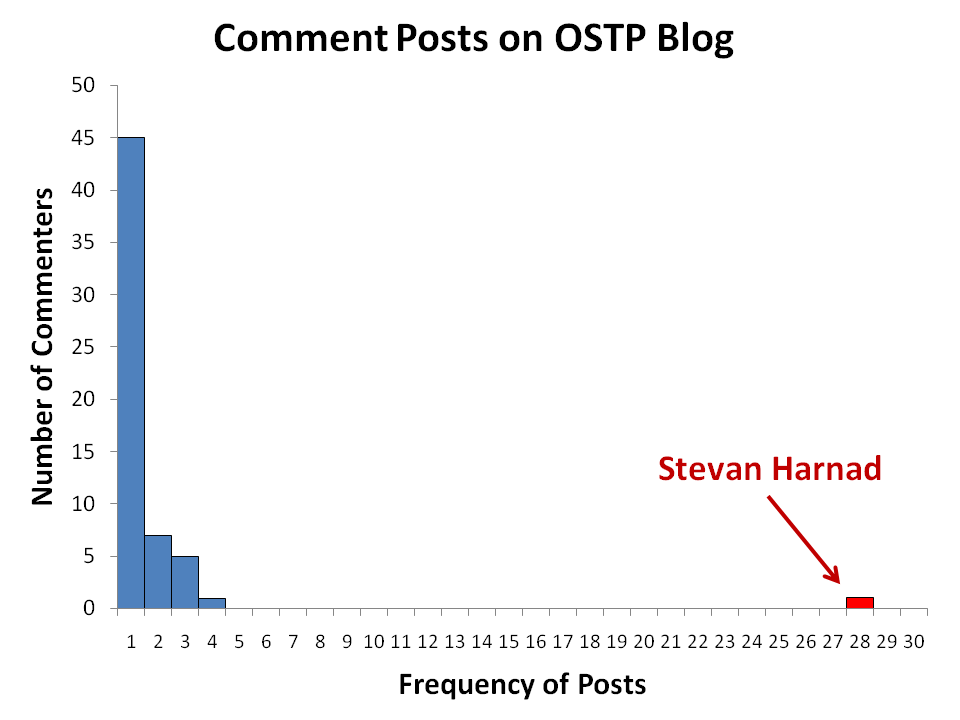
By early Monday morning, there were 106 posts by 59 different commenters. Like in-person public forums, most of the registered commenters were happy to make their statement, sit down, and give others the opportunity to comment.
But online forums don’t always work like in-person forums. At in-person forums, decorum and good moderators prevent certain loose cannons from dominating the discussion. These blowhards are given their time and asked politely to sit down. We don’t tolerate these individuals very well because, deep down, we feel that they are disruptive to democratic discussions where diversity is valued over dominance.
It’s not surprising that one individual has attempted to dominate the OTSP’s online discussion, posting 28 (over 26%) of all the comments to date, tirelessly bullying other participants into submission or exasperation. Responding to Stevan Harnad‘s accusation that the American Physiological Society is anti-open access, Marty Frank was the first to point out Harnad’s inappropriate online behavior:
Let me also say that it is my intent to respond to the questions in the future without commenting on the comments of other responders. Steven, this in not your blog and there is no need for you to do that here.
An online governmental forum allows individuals who lack the financial means and time to travel to such events. They give a voice to those generally not heard outside the Washington beltway. And yet, the OSTP blog is not dominated by powerful inside commercial interests, but by a single professor residing outside of the United States.
What is antithetical to the process of free speech is the OSTP’s blog voting feature, which allows comments to be “collapsed” if a small number of readers give them a negative rating. What is interesting is that this feature is not being used for the purpose for which it was designed — to mitigate against spam and unrelated comments — but to marginalize and silence the small number of alternate voices in the forum.
While many believed the Internet would help to democratize the decision-making process, the features of the OSTP blog (coupled with the tendency of a few to dominate discussions), are working against the very diversity of opinion the OSTP wanted to encourage in the first place.
By the time I finished writing this, two more Harnad comments were posted.
Welcome to online democracy.
![Reblog this post [with Zemanta]](http://img.zemanta.com/reblog_e.png?x-id=cf249b70-12e6-40e4-b30e-55670347e921)

Discussion
25 Thoughts on "Open Science Debate: Democracy or Dominance?"

Stevan Harnad is the Ralph Nader of OA. He’s on our side but he’s in essence working against us.

Phil: “Loose cannons”? “Blowhards”? “Bullying”? Instead of just counting, and insulting, why not read and respond to the substance of what I post? No one is being gagged.
Anonymous “OA Supprter”: Who is “us”?

Online communities very rarely resemble democracies, instead they tend to lead to reduced diversity and what’s called monopoly populism. Another good article on the subject can be found here.

Perhaps it would be wise to limit the number of comments from any one source. I believe C-Span only allows one call per person per month and that seems to work.

I imagine if you plotted a similar histogram of commenters vs. how much they know about the issues, it would overlay the # of comments plot quite nicely.
Stevan Harnad is very vocal, but he’s also very educated about the issues, so you can’t just tl;dr his comments.
Well the voting here certainly suggests that “alternative voices” are not too esteemed in this particular venue!
(But SSP is hardly “us.” “Us” is the research community and the tax-paying, research-funding public. Research is not funded, conducted and published in order to ensure the revenues of the publishing industry but in order to maximize the progress, productivity and benefits of the research.)
Now back to your anonymous voting…
Readership (and commenting and voting on comments) of this blog is not limited to SSP members. Also, many SSP members work for not-for-profit publishing ventures that are parts of scientific research institutions or academic societies, where maximizing progress and benefits of research are indeed the priority.
Having a vast conspiracy of corporate fatcats to rebel against does make for a better storyline, but the reality of the situation is much more nuanced.
But David, I am not a conspiracy theorist, and you might perhaps have noticed that for years I have been trying both to avoid and to discourage publisher-bashing, or vilifying. I consider OA to be a matter entirely between the research community and itself.
I’ll say more shortly on the question of whether there is any fundamental difference between Learned Society or other nonprofit publishers of journals, and commercial publishers, with respect to the conflict of interest between protecting their revenue streams and making research open access.
The issue here, however, was whether my postings to the OSTP Forum justified allusions in the SSP Kitchen to “Loose cannons”? “Blowhards”? “Bullying,” threats to democracy by foreign professors…
So far, the thumbs in the SSP Kitchen (whoever they belong to) appear to feel it was justified…
I’m glad to hear you avoid much of the unnecessary emotional rhetoric that’s been so damaging toward making real progress toward better access. I was responding to your comment that the “SSP” does not represent the research community, a statement you’ve basically reiterated in your response. It’s not a clear black and white distinction, a zero sum game. Many publications are run by and for members of academic societies and academic institutions, the very same people doing and publishing research. If a scientist serves on the editorial board for a journal is he no longer a part of the “research community”?
You should note that this is a group blog, written by eight individuals, with fairly different affiliations. We often disagree strongly with one another, and are not, in any way, an official voice of the SSP.
You have no idea if the anonymous votes on your comments represent members of the SSP, non-members or are even the work of one disgruntled clicker. As noted above in my first comment on this posting, online forums are often not representative of the true opinions of communities they discuss and voting/rating systems are particularly flawed.
You should also note that William Gunn’s comment above (and he’s a strong advocate of Open Science and Open Access) has received more favorable votes than negative ones.
I will address this question of the different hats academics wear when they are authors of refereed journal articles and when they are members of journal editorial boards. For now, suffice it to say that they are indeed different hats, with different allegiances, and the allegiances can be in conflict.

Stevan is right that we should make alternative voices – particularly knowledgeable ones – welcome in these discussions. His is one that I certainly listen to.
But I hope he would also agree that in many such discussions, the knowledgeable voices of non-profit publishers who seek to maximize access without sacrificing the benefits (to scholarship) of existing publishing models are also often drowned out – to the extent that merely questioning claims made in favor of OA or pointing out drawbacks of particular OA models leads to one being labeled self-interested.
Richard, I am not in general — nor have I on OSTP in particular — given to making ad hominem remarks, nor even of expressing any great interest in motives. My emphasis is on what needs to be done, practically speaking, to provide OA, and in correcting the widespread misunderstandings about whether, how, or why this can and should be done.
In the SSP Kitchen allusions have been made to “Loose cannons”? “Blowhards”? “Bullying,” and threats to democracy by foreign professors. I have a certain amount of experience with open peer commentary (having umpired it for 25 years), so I am quite interested in examining further why some seem to feel it is preferable to just count my postings and call them bullying rather than to read, understand and reply to their substance.

Goodness knows I don’t always agree with Phil – but in this case… I think it is entirely inappropriate for any one individual to try to hijack the conversation on the OSTP blog. I believe that is is entirely inappropriate that a non-U.S. citizen do so. They want concise feedback from a variety of viewpoints – this is open government, not some listserv or private blog.
(btw, I am NOT a member of SSP – nor will I ever be, and I voted up on the Nader comment)
A small point of information:
If the OSTP had set up a Forum to advise President Obama on what is and is not a prime number, and if many individuals were posting candidates such as 18 or 144, would Christina Pikas consider it “hijacking” if one individual kept posting along the lines of: “No, 18 is not prime, because 3 x 6 = 18,” and “144 is not prime because 12 x 12 = 144″…?
And would the hijacking be even more “inappropriate” if the hijacker were not a US citizen?
And are “viewpoints” simply the airing of tastes, or are they answerable to evidence and reasoning too?
For if the only interest is in tallying viewpoints, surely it’s easy enough to tally them by the individual poster instead of the number of postings.
Whereas if the interest is in evidence and reasoning, the individual matters less; the individual’s citizenship less still…
Or is President Obama to be kept innocent of evidence and reasoning if they come from a non-US citizen? Or in more than one posting from the same individual?
THE SPECIAL CASE OF LEARNED SOCIETY PUBLISHERS
I promised to give a careful response to the special case of learned-society publishers and conflicts of interest:
(1) Learned-society publishers do differ significantly from commercial publishers in that they contribute some (and in some cases most) of their net publishing revenues to good works such as subsidizing conferences and scholarships.
(2) The only point at issue is whether or not a publisher endorses OA self-archiving, by its authors, of their refereed final drafts, in their institutional repositories, immediately upon acceptance for publication (“Green OA”).
(3) Sixty-three percent of journals (51% of publishers) already endorse immediate OA self-archiving; the rest either do not endorse OA self-archiving, oronly after an embargo. http://romeo.eprints.org/stats.php
(4) I haven’t counted, but the 63% Green publishers seem to include most of the major commercial publishers as well as many of the learned-society publishers. http://romeo.eprints.org/publishers.html
(5) Although this suggests that subsidizing good works may not be a decisive feature distinguishing the Green publishers from the Pale-Green, and Gray ones, let us assume that the main argument for a learned-society (e.g., the American Chemical Society) not being Green is that it wants to protect the revenues needed to subsidize its good works. http://romeo.eprints.org/publishers/4.html
(6) The conflict of interest is then that between maximizing research access, usage and impact on the one hand, and subsidizing learned-societies’ good works on the other.
(7) The proposed embargoes on making deposits OA are a provisional compromise between these two conflicting interests.
(8) But what is not at all clear is whether (8a) endorsing immediate Green OA would indeed diminish publishers’ revenues and (8b) whether the author community, if offered the choice between maximizing the access, usage and impact of their papers versus subsidizing learned societies’ good works would choose the latter.
(9) For the time being, authors are not facing this choice, because most are not self-archiving spontaneously: that is what the proposed self-archiving mandates are for.
(10) Green OA mandates will grow anarchically, funder by funder and institution by institution, not journal by journal or publisher by publisher.
(11) The effects, if any, of Green OA on publishers’ revenues will begin to be felt only when Green OA mandates have become widespread enough to cover all or almost all of individual journals’ contents, hence making it possible for institutions to cancel subscriptions to journals all or almost all of whose final refereed drafts their users can now access free online.
(12) Then the question is whether the institutional subscription demand for the print edition and the publisher’s online edition will remain sustainable.
(13) If not, publishers can convert to the Gold OA publishing-fee model for cost-recovery, by the individual paper, and institutions can pay for it out of the same windfall subscription cancellation savings that induced the transition to Gold OA.
(14) Whether the Gold OA market will sustain a Gold-OA fee that includes a mark-up for learned-societies’ subsidies for good works will become known at that time; it may only cover the cost of peer review.
(15) If not, then learned societies will have to find other ways of subsidizing conferences and scholarships.
More on this:
Papers: http://bit.ly/7jodfW
FAQ: http://www.eprints.org/openaccess/self-faq/#19.Learned
AmSci Forum: http://bit.ly/6FRwXs
Blog: http://bit.ly/5ga8zf
What became of my posting on learned societies and conflict of interest?

It got caught by our spam filter. I had to dig it out. Lots of links in a comment will do that sometimes.
Many thanks, Kent! — S

Concerning Stevan Harnad’s comment being caught in a spam filter, I discovered that every email sent to me for a period of time that mentioned Harnad had gone to spam, even though I never once tagged Harnad as a spammer. I believe the explanation is that the cumulative votes by other users, in which Harnad’s posts were tagged as junk, resulted in the algorithm assuming that anything Harnad sent out must in fact be spam. I have now systematically marked the Harnad items as “not spam,” which may mean that users who are trying to block him are now receiving his messages.
A little Exercise in logic, for the benefit of JE:
SPAM: “Unsolicited e-mail, often of a commercial nature, sent indiscriminately to multiple mailing lists, individuals, or newsgroups; junk e-mail” http://www.thefreedictionary.com/spammer
Since all email list postings are unsolicited, the defining feature of spam is hence *indiscriminate* (otherwise anyone who sends email — individual or multiple — is a spammer except if the message was solicited in advance).
I created in 1998 an email list (the American Scientist Open Access Forum) that is devoted to (what is now called) OA.
http://amsci-forum.amsci.org/archives/American-Scientist-Open-Access-Forum.html
Indiscriminate posting to lists means postings that are off-topic. (I don’t think anyone has ever accused me of off-topic posting: My postings are all very tightly focused — some would say to a fault — on OA.)
I post to the AmSci OA Forum, and I often cross-post also to other OA Forums (the SPARC OA Forum and the BOAI Forum), sometimes also to the JISC Institutional Repository Forum, and, where relevant, to two library lists (serialst and liblicence) or, rarely, to a scientmetrics list (sigart).
Now if there is software that links SSP Kitchen blog voting to individuals’ email filters, so that blog postings that receive many anonymous SSP blog thumbs-down votes are filtered out of individuals’ email (which I rather doubt) then that is a bug in the blog software. I think Kent was probably right that the SSP blog spam filter is not for individual emails but for blog postings, and is based on a URL-count.
So the fact that JE is being deprived of email from me probably has nothing to do with the SSP blog filter for postings. An individual’s email software can filter incoming emails, a blog’s posting software can filter postings, and a blog’s email-alert software can filter individuals’ outgoing email alerts for postings to that blog, but they cannot influence other emails to and from individuals.
So I think JE was just trying to say that he feels that I am a “spammer” (and he has since managed to say that more directly in Zoe’s THE blog, together with a mysterious remark about courtesy)…
But I don’t post to express, discuss, or injure feelings. I am here interested in a point of logic: Is “spamming” now to be defined as the frequent, highly discriminating posting (often by way of critique or rebuttal to other postings) on substantive, on-topic points of logic and evidence that happen to be unwelcome to some individuals’ ears? Indeed, is that also the definition of “bullying”?

Readers may be interested in this story on the case published in the UK based Times Higher Education magazine:
http://www.timeshighereducation.co.uk/story.asp?storycode=409773