Editor’s note: Today’s post is by Nicola Jones, Director, SDG Programme, Springer Nature, and Katie Shamash, Head of Data, Overton.
As Global Goals Week prompts renewed focus on the Sustainable Development Goals (SDGs), it’s a timely moment to reflect on how scholarly research is contributing to real-world change. In keeping with our own SDG commitments, Springer Nature and Overton have collaborated on a joint analysis on the relationship between research and policy.
We will publish a full report later this year but first wanted to share the headline findings with our community now, during Global Goals Week.
Why This Matters
The 2025 Sustainable Development Report, which reviews progress made towards the SDGs each year, found that global commitment to the Goals remains strong, with 190 out of 193 countries presenting national action plans for advancing sustainable development. And while governments and organisations are responsible for implementing the Goals, our industry has a role to play, as custodians of scholarly research and knowledge, to ensure that policy is informed by the most reliable and current evidence.
Quantifying impact is challenging but necessary. Overton Index — the world’s largest database of policy documents and their citations — helps measure the impact of research on policymaking. Initiatives like the Royal Society’s Pairing Scheme and Sage’s Policy Profiles (also developed with Overton) are attempting to help bridge this gap in the qualification.
Our Approach
Rather than categorising research by SDG topic, we started by looking at how policy documents relate to the SDG targets and then traced the research they cite. This method gives us a clearer picture of how evidence is being used in practice, whether to shape legislation, guide funding decisions, or inform public programmes.
We used Overton’s updated SDG classification system to identify policy documents linked to the Goals and analysed citation patterns across thousands of documents. The findings offer actionable insights to increase the societal impact of research.
Key Insights from the Analysis
- The topics that the SDGs address have been important since before the Goals were adopted
Since the SDGs were introduced in 2016, the proportion of policy documents linked to them has remained stable as far back as 2000. Meanwhile, SDG-related research output has been growing faster than the overall market — even before the Goals were formally adopted.
Taken together, this suggests that the SDGs have reinforced existing areas of research and policy activity, rather than redirecting them. In other words, the Goals have helped focus attention on issues that were already seen as critical.
- SDG policy documents seem to cite more research than non-SDG policy
While most policy documents don’t cite any research at all, those that do and are linked to the SDGs are more likely to reference scholarly work than those not related to the SDGs. This is a positive indication that research IS being used to inform responses to global challenges.
However, it’s important to note that citation alone doesn’t guarantee impact. “Policy document” is a broad category, and many, such as budgets or meeting minutes, don’t cite research simply because of their format. Our analysis controlled for this by focusing only on documents that included references.
- Think tanks, NGOs, and IGOs are key knowledge brokers
Among the distinct types of policy organisations, think tanks, non-governmental organisations (NGOs), and intergovernmental organisations (IGOs) are the most likely to cite research in SDG-related policy documents.
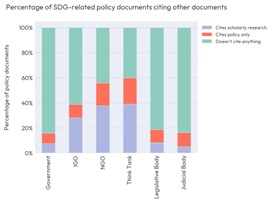
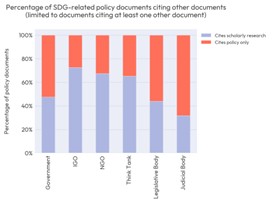
Think tanks, in particular, often serve as intermediaries — translating academic findings into actionable insights for governments and other stakeholders. Their documents are also frequently cited by other policy organisations, amplifying the reach of the research they reference.
This highlights the importance of engaging with these organisations to increase the policy impact of research. It also suggests that researchers and institutions should consider partnerships and outreach strategies that target these influential actors.
- Global North research dominates SDG policy citations
Notably, 78% of research cited in SDG policy includes authors based only in countries in the Global North, including the US, UK, Canada, and EU member states. In contrast, policy documents from the Global South often cite little domestic research.
This aligns with previous findings that researchers from the Global South are underrepresented in development research. However, there are notable exceptions. In India, for example, Indian research is cited in SDG policy at a comparable rate to US-produced research. Similarly, Brazilian research is cited more frequently in Brazilian policy than Mexican or Argentinian research is in their respective national policies.
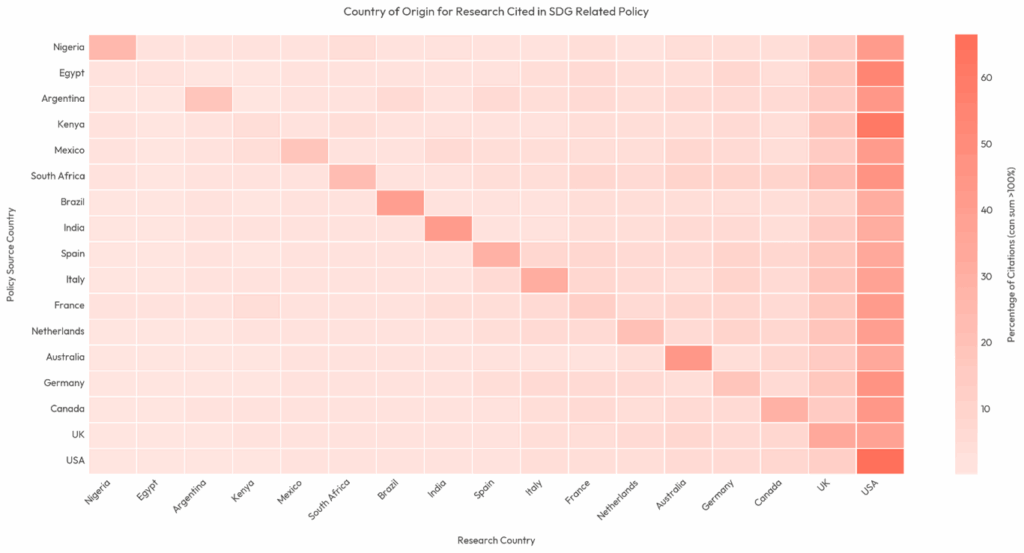
These findings raise important questions about equity, representation, and the accessibility of research across regions. They also underscore the need for more globally inclusive publishing practices.
- Open access (OA) articles are more likely to be cited in policy
Accessibility matters. Our analysis found that OA articles are cited more frequently and more quickly in SDG policy documents than subscription-only content. This makes intuitive sense: policymakers often lack access to paywalled research, and OA helps bridge that gap.
We looked at a subset of 11 SDG-related Springer hybrid journals and found that OA articles had a higher average number of policy citations and a shorter time to first citation. This reinforces the value of OA not just for academic visibility, but for societal impact.
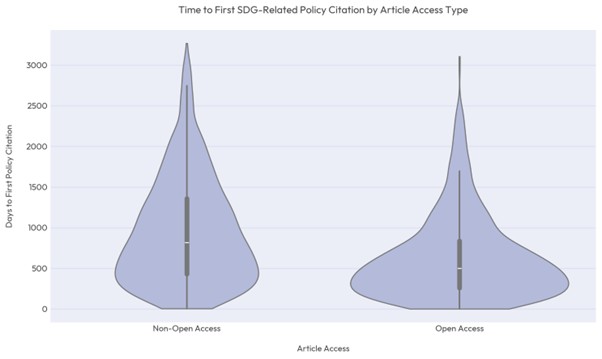
It’s worth noting that OA status is influenced by many factors, including funder mandates, institutional support, and author intent. These variables can also affect citation likelihood, so the findings should be interpreted with some caution.
- Journal selectivity does not significantly affect policy impact
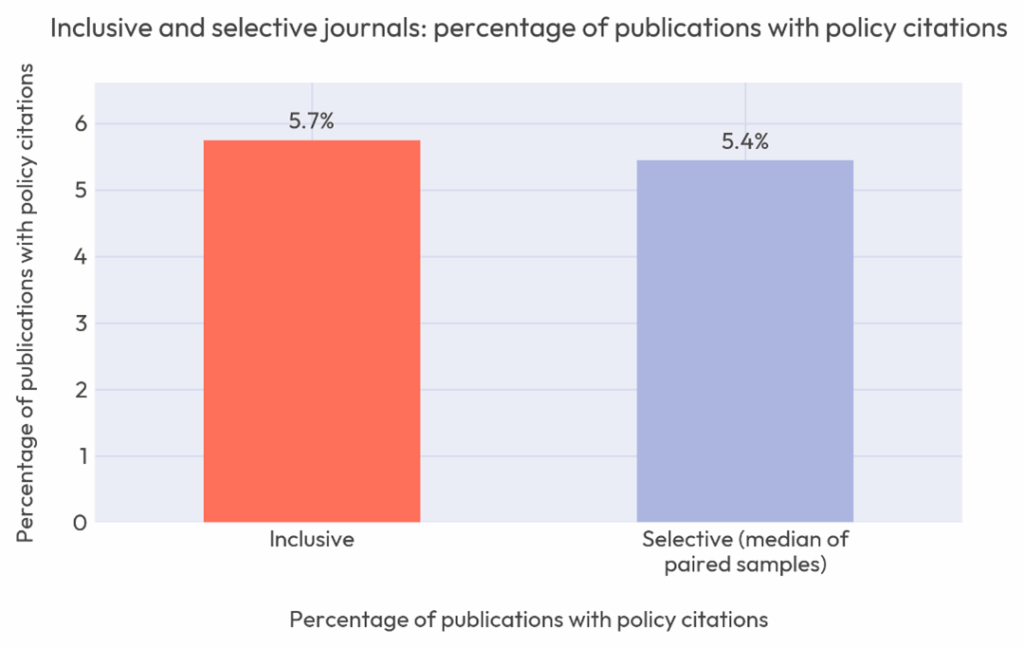
We compared matched sets of articles from Springer Nature’s inclusive journals (which publish technically sound research regardless of perceived significance) with those from selective journals (which screen for impact and novelty). Both sets were OA, and publication volume was controlled for, as well as topic, publication year, and article type.
The result? No significant difference in policy citation rates. This suggests that all validated research has the potential to inform policy, regardless of the journal’s selectivity. It’s a powerful reminder that relevance to global challenges matters more than prestige.
- Reviews, letters, and news articles are highly cited in policy
For this analysis, we looked at the Nature Portfolio research journals, which publish extensive news, opinion, and summary content, in addition to original research papers. While primary research articles make up the bulk of citations, reviews, letters, and news pieces are cited at higher rates relative to their publication volume. For example, 27% of review articles and 14% of letters received policy citations, compared to 9% of primary research articles. News articles were cited in SDG policy at a similar rate to original research papers, but received about a third as many academic citations as primary research.
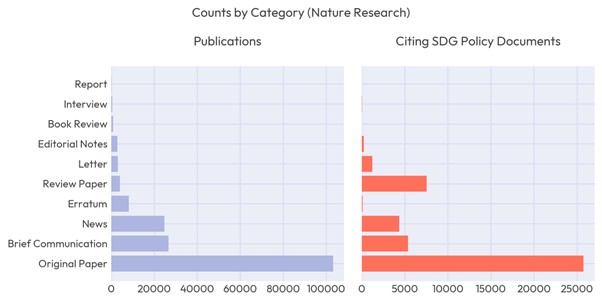
These formats help make complex findings more accessible to non-experts, which is a crucial factor for policy uptake. News articles, in particular, play a role in translating research for time-pressed audiences. This underscores the importance of diverse forms of science communication in driving impact and shows that accessibility of research content goes beyond availability of an article.
Caveats and considerations
As with any analysis, there are limitations. The Overton database may miss policy documents from regions with limited online access or restricted formats. For example, Chinese policy has limited public availability. Citations don’t always reflect direct impact, and time lags between publication and policy can underrepresent recent research.
Policy citation is a proxy for impact, not a direct measure of societal change. More work is needed to understand how cited research influences outcomes on the ground.
What’s next
We will be publishing the full report later this year, with detailed recommendations for publishers, researchers, and institutions, and we will also be presenting our early findings at Frankfurt Book Fair.
Beyond publication, we’re keen to see how new initiatives that are being developed by publishers (such as Nature Energy’s policy briefs) and industry groups (for example, the SDG Compact Fellows’ top action tips for connecting with policymakers and practitioners) help to facilitate this translation of knowledge into action. We also couldn’t discuss impact without mentioning Artificial Intelligence (AI). We know new technology presents opportunity: from automated information synthesis to accelerated publishing processes that will help get verified, reliable knowledge to the people that need it faster.
With just five years until the endpoint of the SDGs, discussions are underway about what a post-2030 agenda for sustainable development should look like. We passionately believe that high-quality research evidence goes hand in hand with solving global challenges. There’s a lot to continue watching and discussing, and we hope this report is just the start.


Discussion
2 Thoughts on "Guest Post – From Publications to Policy: How Research Is Driving Progress on the SDGs"

Many thanks to the authors for this very important and spot-on summary, your research has clearly led to new findings that will undoubtedly help us all increase the impact of academic research.

It is great to see that SDG research are making impact in policy decisions.