On March 26, 2025, I wrote a piece in The Scholarly Kitchen titled “Five Trends In The Publishers-Sustainability Nexus”. The article received no comments from the readers of the blog, but I wasn’t surprised or disappointed. Between my that article and today’s article, The Kitchen published six other pieces on sustainability and/or the Sustainable Development Goals (SDGs), each receiving very few or no comments, as indicated in the parentheses: an update on STM’s SDG Roadmap (2), the relationship between research and progress on the SDGs (2), tips for hosting sustainable events (6), digital carbon footprint of publishing (2), sustainable practices in the EASE 2025 conference (1), and IOP Publishing’s first online sustainability report (0).
In recent years, the volume of comments in The Kitchen has decreased. But, articles on AI still receive a lot of comments, and so do articles on integrity, infrastructure, and mental health, for example. The reasons for low attention to sustainability topics might be due to low awareness levels among the readership, low interest of the industry as a whole, or the topics not being quite controversial, like proposing a new peer-review model. This prompted me to explore if there exists some sort of inertia around sustainability/SDG issues in the scholarly publishing.
Taking stock of scholarly publishing
First, let me revisit some numbers I compiled on March 26, 2025.
Signatories of the ‘SDG Publishers Compact’
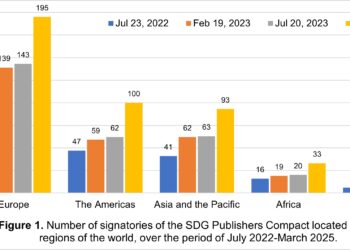
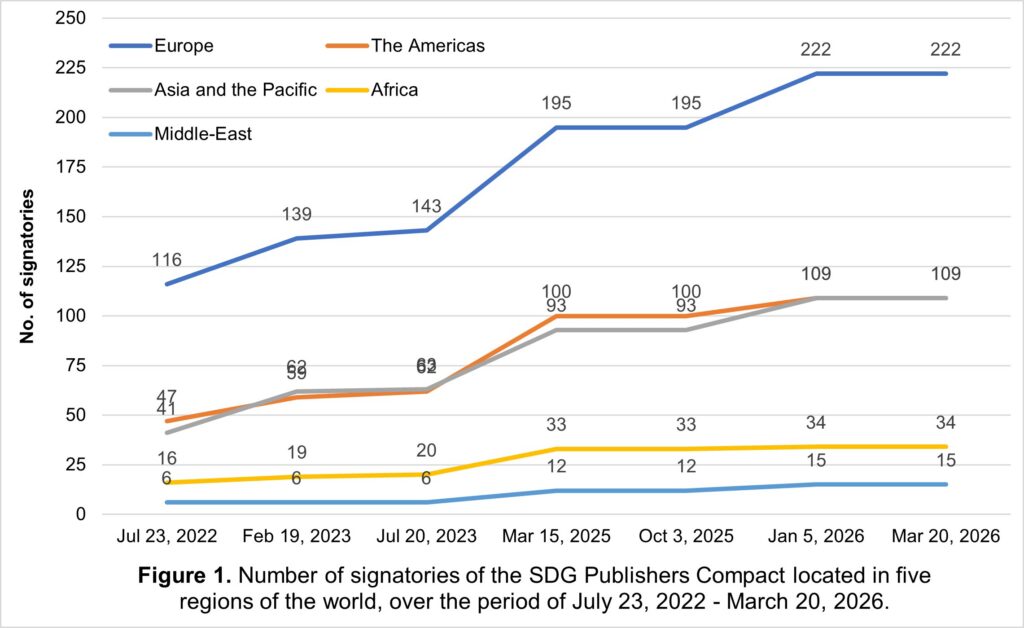
This Compact was made public in October 2020 to encourage publishers to adopt 10 key action points and contribute to the SDGs. The total number of signatories shows an encouraging 2.16 times growth between July 2022 (226 Compact signatories) and January 2026 (489). Figure 1 below shows us four regional trends. First, Europe hosts a significant portion of the total signatories (45%, as of March 20, 2026). It has also been showing good annual growth over the last approximately four years. Second, the Americas, which includes the USA (50 signatories), is significantly lagging behind Europe. Third, all regions but Europe showed good annual growth until March 2025, but since, have been more or less static. This is surprising for Asia and the Pacific, especially when it has large countries like India (45 signatories) and China (3 signatories). Fourth, Figure 1 also shows that, in the first few months of a year, not many new signatories are added. Of course, this could also depend on how frequently the Compact website is updated.
Resources on the ‘IPA SDG Dashboard’
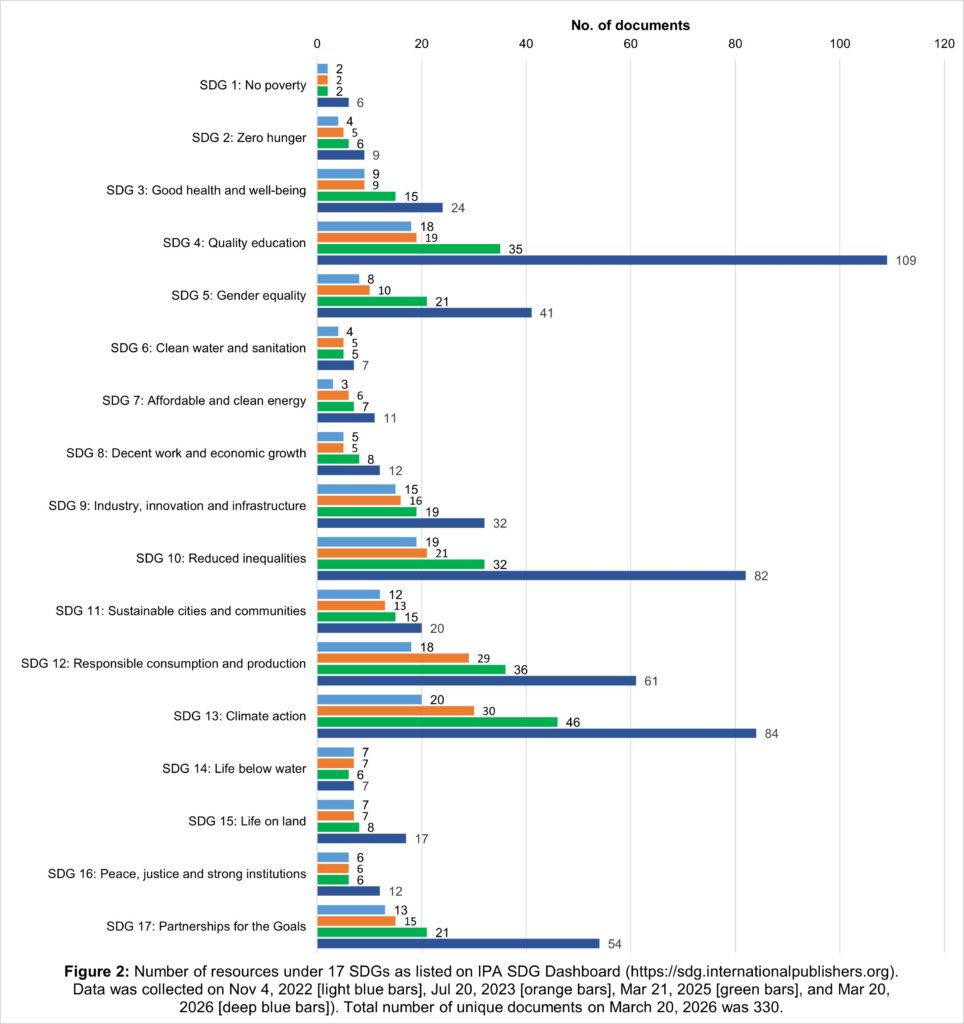
This Dashboard of the International Publishers Association (IPA) is a very useful compendium of SDG-related resources in scholarly publishing. On March 21, 2025 this platform had 291 unique items, which exhibited 13.4% growth by March 20, 2026. Although the overall growth of the platform is moderate, individual SDGs show significant growth, especially the SDGs 4, 10, 12, 13, and 17 (Figure 2). This is essentially because one resource is now listed under more than one SDGs. In my last year article, I raised some discrepancies seen on this portal; several of which now seem to be addressed. Nevertheless, the latest 330 unique resources on this platform are due to the addition of 39 new items over the past 12 months. But, if this annual growth rate is maintained, it will take IPA until the year 2043 to reach the envisaged ‘1000 actions’ target. This target was supposed to contribute to the United Nations’s (UN) campaign of 1 million SDG actions, which was already achieved in July 2024.
Articles in Learned Publishing and The Scholarly Kitchen
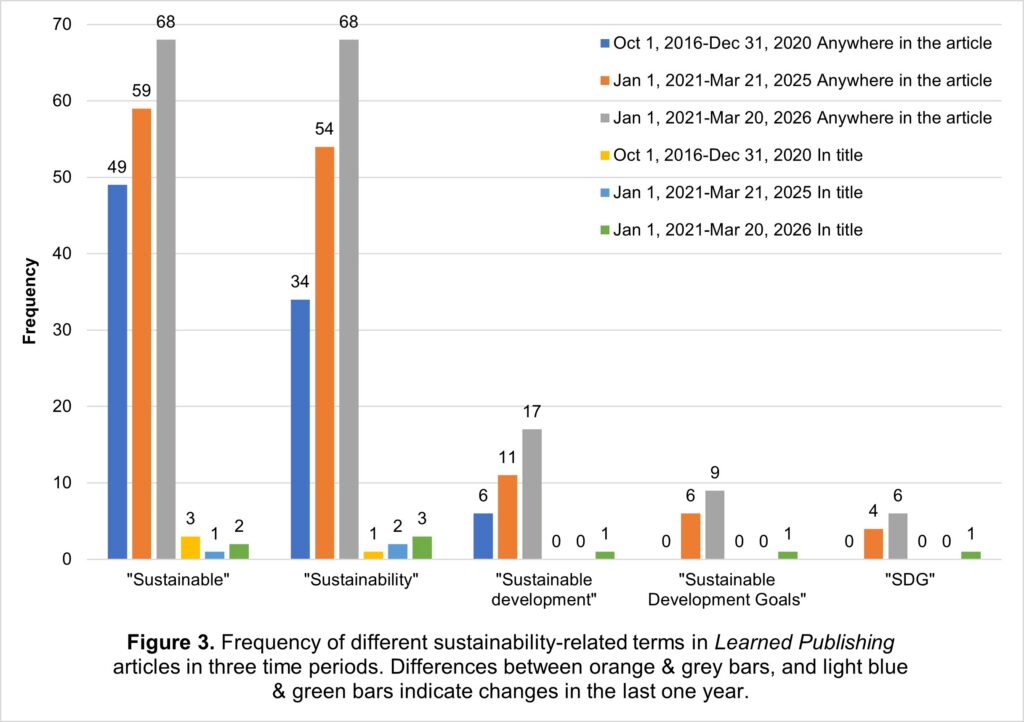
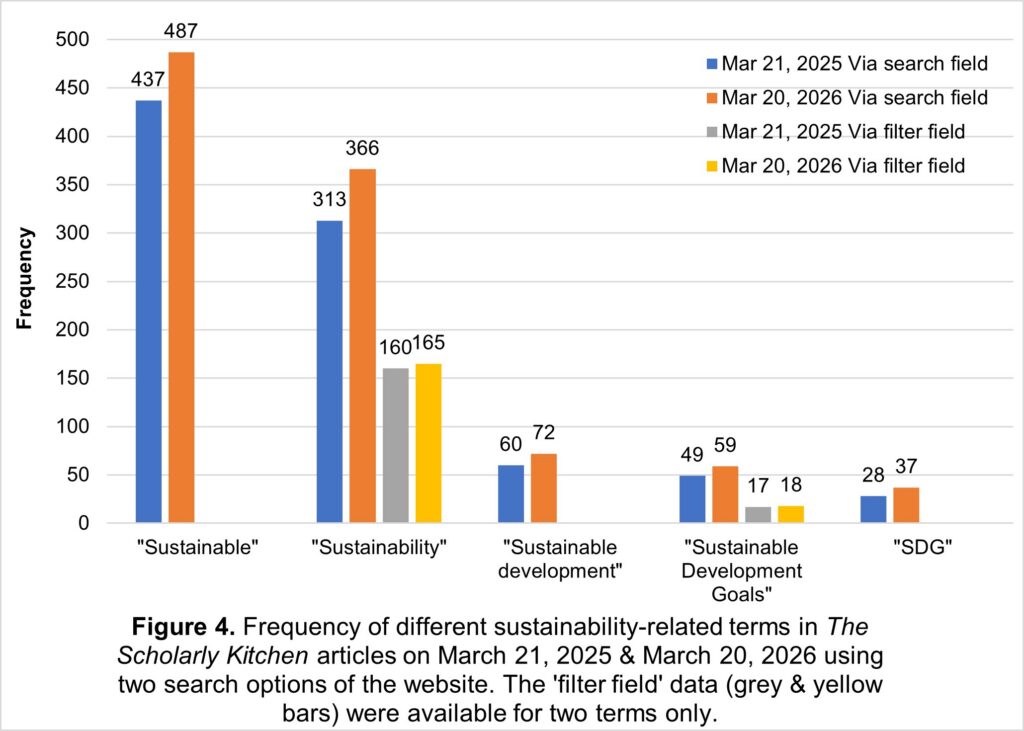
The journal Learned Publishing continues to publish articles with sustainability-related terms in them (Figure 3). On April 7, 2025, the journal published its first article with “Sustainable Development Goals” and/or “SDGs” in an article title – Is Editors’ Awareness of Sustainable Development Goals (SDGs) a Determinant of the Journal’s Contribution to SDGs? On the other hand, the same sustainability-related terms increased significantly in the articles published in The Scholarly Kitchen over the last 12 months (Figure 4). However, the number of tagged pieces (with inbuilt filter themes “Sustainability” and “Sustainable Development Goals”) showed very slow growth.
Annual meetings of publishing societies
In my previous instalment on this topic, I also showed how, since 2021, different publishing associations had been showing interest in organizing sustainability sessions in their annual conferences. Over the past year, however, most of those organizations didn’t organize any dedicated session on sustainability or the SDG aspects: Asian Council of Science Editors (ACSE) (February 2025), Council of Science Editors (CSE) (May 2025), ALPSP (September 2025), OAPSA (September 2025), STM Association (October 2025), and Academic Publishing in Europe (APE) (January 2026). A couple of organizations, such as, Society for Scholarly Publishing (SSP) (May 2025) and Researcher to Reader (R2R) Conference (February 2026) organized sessions on sustainability of open access business models, or non-profit publishing, or open science infrastructure.
We also saw European Association of Science Editors (EASE) upholding its SDG mandate in its annual meeting (May 2025) by having two organizational posters on sustainability (EASE Environment and Sustainability Committee: Growing a Sustainable Future and EASE Environmental and Sustainability Committee: Greening your Conference), and having a session titled “How can you contribute to your journal’s sustainability”. The session discussed the new EASE SDG Checklist co-developed by EASE’s Environment and Sustainability Committee and Equity, Diversity and Inclusion Committee. The Checklist is now freely available to publishers and journals to use to track their progress and reporting on SDG-related actions.
The world only has four years left to achieve the SDGs. The overall progress, however, is not good. The UN’s SDG Report 2025 shows that 35% of the 139 assessable SDG targets are either on track or have made moderate progress. Alarmingly, after 10 years, 18% of assessed targets are now below the 2015 baseline. Due to a lack of a comprehensive database, it is difficult to say how the publishing industry is responding to its responsibility in meeting the SDGs. So far, we have the UN’s progress report on the Compact(October 2023), and the EASE’s related survey of 2022 (article published in October 2024); but both are essentially baselines, not progress reports. Besides the recent progress noted in the opening and the subsequent paragraphs of this article, we may find some sporadic institutional progress reports, some of which might be available on the SDG Dashboard. Nevertheless, the slow global adoption of the SDG Publishers Compact, the low generation and subsequent inclusion of new items into the SDG Dashboard, not many SDG articles being published in academic journals on publishing, and hardly any discussions on SDGs/sustainability in societies’ annual meetings, in the recent year, do indicate industry’s ‘SDG inertia’.
Reframing the SDG’s 2030-timeline
2025 was indeed an anxious year for scholarly publishing due to the US government’s attack on research funding, development budgets, science as a whole, and, of course, on DEIA. These adversities seem to continue in 2026, in different modes, given the development budget cuts by other governments in the Global North. The issues of sustainability and resilience are more important for the publishing industry than ever before. Given the low progress the world has made so far on the SDGs, scholarly publishing must not consider the ongoing SDG efforts as meaningless and doomed to failure. Because our journey towards sustainable development does not end in 2030, the SDGs is not the last framework that will guide us.
I want to propose a different notion for the publishing industry to consider. First, the industry was five-year’s late in joining the world’s SDG journey. It only started talking about the SDGs widely when the SDG Publishers Compact was announced. I would like to call 2021-2025 the ‘realization phase’. Here, we essentially explored the SDGs, talked about them, started realizing our responsibilities, and began to develop and use tools to track our progress.
Second, in 2026, I now urge publishing entities (publishers and journals) to take stock of their SDG progress made so far. Since there is no sign that the UN is planning to produce another progress report on the Compact soon, the EASE SDG Checklist could be a very useful tool to do it. A guideline is available to use the Checklist for anyone interested. The data collected on the Checklist portal may also help us to track our collective progress, if we decide to do it. I am calling 2026 the ‘stocktaking phase’.
Third, we understand that in the coming years, the UN will start the process of developing the post-SDG agenda. Some organizations have already started talking about it (e.g., the Stockholm Environment Institute’s the Post-2030 Initiative). The scholarly publishing industry should start preparing itself for the beyond-2030 era. I want to call 2027-2030 the ‘readiness phase’ for the post-SDG era. Our webinars, annual meetings, strategies, working papers, and special issues of journals should focus on how to take the SDG’s learning to design the post-2030 agenda. For the post-SDG era, academic publishing should contribute to shape the agenda, not just follow the agenda.

Discussion
4 Thoughts on "How Can Scholarly Publishing Overcome Its ‘SDG Inertia’?"

This is such an important topic to discuss, thank you, Haseeb. Coming from the perspective of a society publisher, I believe the issue isn’t only inertia but also confidence. We know that many in our community care deeply about sustainability but don’t always have the tools, resources or knowledge to know where to start, which can make it feel quite intimidating. This is where collective action is key. There are numerous industry groups focused on creating resources to support all publishers in taking their first steps or continuing their journeys, such as the perfect examples you gave of the STM’s SDG roadmap and EASE’s SDG Checklist (also noting the SDG Publishers Compact Fellows’ Top Action Tips; https://www.sdgcompactfellows.org/top-action-tips-2-1). As a participant in a couple of these groups, I can say that they are also so much more; they are supportive communities of individuals from across our sector that are generous with their time, their experience and their expertise. So I know that I won’t be alone in saying, we’re always happy to share what we have learned from our own journey, if that would help, just ask.

Thank you Liz, for sharing your thoughts. You are absolutely right — there are so many fantastic works already have been done in the sustainability space. There are indeed several platforms where we can find many of those useful tools.
But my ask is how much of those are actually being used, how those are changing our practices, how such changes are creating impact, and how we are collectively contributing to the global/sectoral efforts. Without such regular reporting, it is really difficult to inspire those who are still struggling to join the sustainability discussions/actions by taking the first step.
Although the 10th Action of ‘SDG Publishers Compact’ reads “Taking action on at least one SDG goal, either as an individual publisher or through your national publishing association and sharing progress annually.” by giving ‘individual’ publishers the reporting responsibility, which is rarely happening.
The UN and/or IPA are natural choice to collate collective progress given their convening power and also given their pioneering role to come up with the idea called ‘SDG Publishers Compact’. As they are not moving fast enough in that direction, can publishers societies conduct ‘sustainability stocktaking’ at least of their own members? That should be relatively more manageable, right?

You should not be “angry” that your excellent articles don’t get published reviews. Reasons that I consider important are lack of interest to write a review (like me), the lack of proficiency in English (China is a great example) and many other reasons. Now to your current article, I think the lack of integration is the main reason for not writing and reporting on SDGs. The education has the highest number of articles not because it is important but because so many people find it easy to write about it and criticize the situation. Compared with AI, SDGs all are experts in AI but not in SDGs. Good article, references and statistics, any why.

A great article and I appreciate the important role that the SDG Publishers Compact—led by the International Publishers Association in collaboration with the United Nations—has already played in mobilizing the sector. It has helped create shared commitments, common language, and visible momentum across publishers of all sizes. However, as your post suggests, commitments alone don’t automatically translate into systemic change, and the Compact’s next phase may need to focus more on accountability, integration into workflows, and measurable impact.
One angle that could further strengthen this discussion is the shift toward post-2030 thinking highlighted in Elsevier’s Beyond 2030 report. That work emphasizes that progress is not just about accelerating current SDG-aligned outputs, but about rethinking the time horizons, incentives, and systems that underpin research and publishing. In other words, inertia may stem less from lack of commitment and more from structural alignment with short-term metrics and fragmented knowledge ecosystems.
As broader SDG research has shown, siloed approaches and limited integration across goals continue to slow meaningful progress, despite growing volumes of SDG-labelled research . The Beyond 2030 perspective suggests that publishers could play a catalytic role here—not only by curating SDG content, but by enabling more systemic, cross-domain knowledge flows and supporting longer-term, mission-oriented research narratives.
If scholarly publishing is to overcome inertia, perhaps the question is not just “how do we do more for the SDGs now?” but “how do we redesign publishing to support the sustainable transformations that extend well beyond 2030?”