- Image via Wikipedia

It’s not surprising until you think about it, but a recent post by Jakob Nielsen brought it all home in a new way:
Text is a user interface.
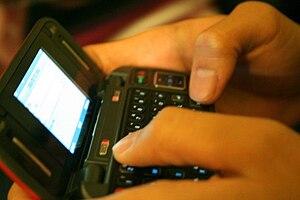
Now, perhaps more than ever, knowing how to deploy text in digital environments is vital to success, as link-dense pages, Facebook updates, Twitter streams, text messages, and emails traverse the interwebs.
And while wordplay is nothing new, new constraints (both social and technological) on our textual communications are driving new behaviors and new forms of inventiveness.
Nielsen‘s post concerns itself with generating a marketing message via Twitter, and the rapid iteration to the most effective and economical use of the 140 available characters.
He also details the decision-making that went into the send time for his Twitter marketing. Since Twitter is a stream-based communication medium, calculating the window for optimum visibility across multiple time zones was a bit tricky. It’s not like email, where it sits and waits. You have to be on the first page of the stream or you’re toast.
Words highlighted in a certain way reveal themselves to be links, both in navigation and in text like this blog post. In fact, these links are vital to a blog’s usability and deeper interest. And text links are what keep Google and others sniffing.
Small URLs from TinyURL or bit.ly are other forms of words as user interface.
Because writing for new interfaces is different, we’re finding ourselves composing more captions, tags, and labels, telegraphic modes of inserting text into the user interface. There’s more use of ellipses for humorous effects and dramatic pauses; consistent deployment of smileys and emoticons (even though Abraham Lincoln might have invented the smiley); and the IMPROPER use of capitalization can accidentally MAKE people think you’re SHOUTING.
Cursing in the new era is something altogether different, a signal of new social mores, mostly those created by the “I don’t know who’s going to be reading this and how long it will be out there” feeling.
And there are prudish profanity filters on more and more systems. So, dollar signs substitute for $’s so that people can get A$$ past a filth filter, and cartoon swearing (#&*@!?*%) is employed.
We even have to respond to typewritten challenges from the likes of reCAPTCHA — scrambled, distorted, fuzzed characters meant to thwart machines.
By becoming part of the user interface, text is being radically altered in some key ways, from the short bursts of communication we’re all becoming more adept at, to the mix of thoughts and links we publish, to the social mores of textual communications.
What other changes have you noticed in how you write?
Oh, that’s another thing — now, we expect to be able to comment. And that, perhaps, is the greatest change in the usability of words.
![Reblog this post [with Zemanta]](http://img.zemanta.com/reblog_e.png?x-id=48522175-45f4-4a3f-be85-fe1fdadd0ad0)

Discussion
1 Thought on "Text as Interface — The Usability of Words"

Copy As Interface:
http://blog.dopplr.com/2007/10/23/the-language-instinct/