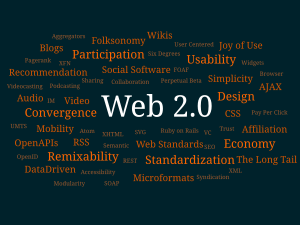
- Image via Wikipedia

Science Online 2010, the annual meeting for cutting edge users of Web 2.0 technologies in science, was held last month. It filled the science blogosphere with coverage and allowed far-flung colleagues to meet in person. Bora Zivkovic, one of the organizers, has written a summary of the meeting, and his perception is that one of the overarching themes was examining media and journalism. But what’s perhaps more telling is what wasn’t a major theme of the conference, as pointed out by attendee Deepak Singh:
There are far too many sessions on journalism and policy, and far too little on doing science . . .
That may explain why so many of the high-profile attempts at adapting Web 2.0 technologies for scientists have failed to catch on, why we haven’t yet come upon the “killer app” that integrates social media into the mainstream of science. Nearly all of the more visible attempts so far have focused on talking about science, rather than tools for actually doing science.
Tools for communication are the low-hanging fruit, the obvious things to build based on Web 2.0 ventures that have worked in other areas, but so far they’ve failed to capture the interest of most scientists. Tools for doing science are much harder to envision and build. But these sorts of tools are much more likely to see uptake and use by the community, simply because scientists are more interested in doing science than they are in talking about science.
Discovery, doing research, gathering and interpreting results, that’s the very nature of being a scientist. There are people whose main focus is talking about science, but we have different names for them — teachers, journalists, editors, and publishers. Talking about science, communicating experimental results, teaching scientific concepts, and reaching out to educate non-scientists are incredibly valuable practices. Communication is an important part of being a scientist. It is not, however, the top priority for most. Nobel Prizes are given for achievements, not for writing entertaining blog entries or clever tweets. Being a good teacher is appreciated, but not as important to a career as uncovering groundbreaking results and securing funding.
Even without new online technologies, scientists already spend a substantial portion of their time communicating. They share results with peers, plan future experiments with collaborators, give talks, write papers, teach, etc. New social media endeavors ask scientists to devote even more time to communication, but it’s unclear where participants are supposed to find that time. Every second spent blogging, chatting on FriendFeed, or leaving comments on a PLoS paper is a second taken away from other activities. Those other activities have direct rewards towards advancement. It’s hard to justify dropping them for activities backed by vague promises that “you will be one of the early adopters and will be recognized and respected for this in the future.” That’s a tough gamble for most to take, and scientists are unlikely to risk current status for a leg up in the event that sweeping societal changes occur in how we fund, employ, and judge scientific achievement.
Self-serving predictions like this about the future are a dime a dozen. Remember that social media shares a lot in common with pyramid schemes. Pyramid schemes and social networks work better with more participants. If you’re involved in a pyramid scheme or a social network, it’s in your best interest to recruit others to join in. So there’s a nearly constant barrage of exhortations to participate, including unrealistic promises of future rewards. Are scientists in the future really going to be given tenure and funding for leaving good comments on the results of others, rather than discovering their own results?
Scientists are no different than other humans. Most people don’t blog. It’s not something they’re interested in doing. Blogging tends to attract those with a strong interest in communication, writing, and teaching, along with activists who are championing a personal cause (that’s why the online science world is dominated by discussions of causes like open access, open science, creationism vs. evolution, and climate change). What you see online reflects this small portion of scientists and may not be all that relevant to the greater community as a whole.
ScienceBlogs has around 80 regular bloggers. The Nature Network has around 40 blogs that have been updated in the last month (this figure seems to have dropped by 20% since I last checked). David Bradley lists 600-plus “science type” users of Twitter. Even if these numbers are just the tip of the iceberg, and there are 1,000 times that number of scientists involved, you’re still talking about a very small percentage of the tens of millions of working scientists in the world. Science blogging is a tremendously insular world, and frequently an inwardly-gazing one. It’s often noted that the most common topic covered by science blogs is science blogging.
Tools like blogging can be effective and useful, but they’re for talking about science, and that’s very different from tools built for actually doing science. The success and high visibility of things like Facebook, Twitter, and blogs has driven much of the development of Web 2.0 tools for scientists. These things worked in other arenas, why not here? It’s low-hanging fruit though, trying to shoehorn pre-conceived ideas into different communities rather than coming up with more ambitious new ideas developed directly for that community.
In the age of the sequenced genome and systems biology, scientists are more and more often dealing with enormous data sets. Experiments require collaboration on a scale never seen before. Though they’re just in their infancy, tools to store, process, and interact with data are more likely to draw scientific users than blogging platforms. These are much harder to conceive and develop than yet another “Facebook for scientists.”
Databases like HapMap and Chemspider are increasingly useful. Community-built resources like WormBase/WormBook/WormAtlas are great examples of projects that have drawn researchers into donating their valuable time and efforts. All of these take principles of Web 2.0 — from crowdsourcing to remixing of previously available data — to build new tools that create efficiencies. Information is aggregated and can be processed in one step, rather than having to gather and try to tie together data from disparate sources. It’s still the early days for these types of resources, and likely the really useful groundbreaking ones are still ahead of us.
Science publishers are deeply interested in new web technologies and have been behind many of the higher-profile attempts at social networking for scientists. Perhaps we need to change our thinking on the subject, and divide our efforts into separate paths:
- Communication: Web 2.0 technologies provide superb ways to help us do our jobs better, and publishers should be employing them regularly. Editors and writers should blog and tweet to spread the word about the useful results we’re publishing. If our job is to facilitate the communication of knowledge discovered by our authors, we need to go beyond the published paper. While we’ll be joined in this effort by a small band of scientist-communicators, it’s probably unlikely that we’ll see much participation beyond that. Investing in platforms to provide these tools for something most readers don’t want to do is not an efficient use of our funds or time.
- Tools for Work: Every journal is looking for a leg up on the competition, looking for offerings that make them more attractive than other journals. Instead of offering yet another suite of communication tools likely to be ignored, we need to instead focus on the priorities and needs of our readers. Can we create new resources that support communities or that aggregate information in valuable ways? Can we open up our journals and let others tinker with our content and data to create something new (think along the lines of the Guardian’s open API)? Can we create new efficiencies for scientists, ways to make them more productive rather than tools that ask them to take time away from their research? Can we develop tools for doing science, rather than tools for talking about science?
Creating new resources and experimenting with new technologies is often an expensive and time-consuming endeavor. We need to stop wasting our efforts copycatting ideas that may work for other situations and instead focus on the communities we serve. Communication tools can be put to great use, but we shouldn’t settle for them just because they’re obvious and easy to build. Finding ways to help scientists spend more time at the bench and to get more out of that time will succeed where the current crop of peripheral distracting tools have failed.
![Reblog this post [with Zemanta]](http://img.zemanta.com/reblog_e.png?x-id=28f2ee41-7019-4871-8149-568e4b38b1e6)

Discussion
106 Thoughts on "Science and Web 2.0: Talking About Science vs. Doing Science"

Interesting view from the outside. Says something about perceptions.
I was hoping you’d come this year. Perhaps next one.
As I said in my summary you linked, the theme changes every year, and it is dependent on who comes, thus on who is shaping the program.
How will be more techno-geeks there next year? If techno-geeks, people like Deepak, rally the troups, do the networking, do the marketing, and persuade more such people to register next year, volunteer to lead such sessions, etc. than it will happen.
How do we get more non-geeky, top research scientists to come, those who like to voice the “I have no time” excuse? The people who said “I have no time” for e-mail 10 years ago? I don’t know, though we are already in the process of coming up with strategies for doing exactly that for next year. But we can use some help – people like you should spread the word: tell scientists how awesome the conference was (send them the links to the Blog/Media coverage, or the wiki page “nice thing people said about us”. Be a part of the solution, not the problem.
One of the main take-home messages of ScienceOnline2010, and a reason why journalism ‘track’ of sessions was big, lively and important, is because people have come to the realization that, with MSM dying, every scientist will have to do all the communicating – not just to peers, but to the public as well. Otherwise, their careers will shrivel in isolation.

Hi Bora,
I skipped the meeting because (given limited travel funds and time) I was worried that it would be too much “preaching to the converted”. Everyone there was already sold on using online technologies and was actively engaged in doing so. I’m less interested in that than I am in reaching out to those who aren’t engaged. Why aren’t they interested in these technologies, what do they need in order to start using them? I get more of that a regular scientific meeting (not to mention recruiting articles for my journal).
You do make a great point about scientific journalism and how it’s sadly on the wane. Is the solution that every scientist take up the mantle of the journalist? What activities that they currently do will be put aside for this? Are there other solutions possible as well, other ways we can take the quality science journalists we already have and re-employ them in more sustainable ways? Would it be better for an institution to hire a science writer on-staff to do this while the researchers spent their time getting research done?
Yes, all those questions were discussed at the meeting. And also true, there were many scientists at the meeting – they just did not look like stereotypical scientists. Just because some of them are off the bench and earn salaries doing some other kind of science besides research, e.g., communication, teaching or tool-development, does not mean they are not scientists. Once a scientist, always a scientist. And that is OK – this is not a typical science meeting, either.
And, well, there were perhaps 8-10 sessions on the media out of 45 sessions (several of them consisting of 4 mini-sessions, not to mention Ignite talks, Lab Tours, Workshops, etc) that covered many other topics. Diversity of people and diversity of topics is something we strive to have every year. It is just that the almost-necessity for scientists to pick up the slack where dead MSM is leaving a vacuum was one of the most interesting themes this year, among others.
How do we get curmudgeons to realize this? We have been asking this question for years. Some are slowly coming around. Others will see their visibility and prominence shrink. Others will hire publicists.
Most scientists DO have time for this, they just decide to spend it on family, hobbies and other stuff. They also have an erroneous perception that involvement online takes a LOT more time than it really does. There is no requirement for a long, thoughtful essay on a blog every day – some times are busier than others and readers understand that.
Also, if they are working 13 hours a day, 7 hours a week and thus truly don’t have time to have a Life, then there is a problem – there is something wrong either with them, or with institutions they are working at, or with the part of the system they are working in.
Learning how to use Twitter tools for one’s advantage – using Lists, TwitterTimes, HourlyPress and engaging in Mindcasting instead of Lifecasting is something they could easily learn how to do and then use to their advantage – I find Twitter and FrienFeed immensely useful (I do not use my RSS feed reader any more – the important information comes to me instead of me seeking it, because I have chosen who to Follow well, and classified people into Lists smartly and am using the additional tools).
How do we persuade the dinosaurs? One at a time, like everything else. Hand-holding. Demonstrating: “sit down at the computer, let me show you”. A departmental seminar. A session about it at a scientific meeting. Publicity for meetings like ScienceOnline (getting a name they respect in their world as a lure, perhaps). If we just throw our hands up and give up, saying this is impossible, the change will never happen. This takes effort – I am doing it, and organizing ScienceOnline helps many others figure out how to do it when they go home to their institutions. Think of #scio10 as a workshop for early adopters, who then influence their own circles and networks afterwards.
The response I nearly always run into is not “How do I use these tools?”, it’s more along the lines of “Why would I ever want to do that?” To me this means that either 1) we’re doing a poor job explaining why these things are important, or 2) we instead need to find ways to use these technologies that are more obvious and appealing to those beyond the early adopters. Task 1 is difficult to do, given the nature of the culture of science, politics and funding issues, and may require societal changes in order to become obvious. Task 2 seems a more conquerable approach, finding the “killer app”, coming up with something that immediately makes sense to those curmudgeons and doesn’t require arm-twisting.

Really looking forward to reading the article! But the first thing I did was click the link to Science Online 2010, and it takes me to a wiki page for which I don’t have permissions and with no content. I’ll skip the irony references, but might want to update it to hit http://www.scienceonline2010.com/ directly :).
Thanks Jessy–that page was a little different when I first started writing this post a few weeks ago. Link has been corrected.
Sorry – got a spam attack, cleaning it up as we speak.
Try this for now:
http://www.scienceonline2010.com/index.php/wiki/rename/
OK, fixed. The original link should work (the homepage links to the planning wiki where all the useful information resides:
http://scienceonline2010.com/index.php/wiki
Great, thanks Bora, link has been changed again. I like having the wiki as the link as it immediately provides more information to the reader.

Your post really hits home with me. At this point, I like communicating about communicating science. And I like communicating science to people outside my field. But this is partly because I don’t have the option to talk science to people *in* my field, nitty gritty, online. All of a sudden I’m interested in anything “#neuroscience” simply because it’s exciting to know there are some scientists out there using social media and I’d rather be in touch than not. But I’m starting to find it’s more distracting and less useful (e.g. Bora mentioned he can get by without an RSS reader to stay in touch – this is completely impossible for anybody in a specialized scientific discipline – nobody in my discipline is online).
Here’s my proposal: find a discipline with sufficient “Science Online-minded” folks, and invite them to host a session in their discipline at the next meeting. As it is, (my guess is that) Science Online might attract scientists who have a subspecialty but also have a *general* interest in science (e.g. the communication aspect) so they end up talking about their common interest (communication) and not their field of science. Scientists normally devote time to, and attend conferences that relate to, their field – so provide that.
If practicing scientists come to discuss their science with fellow researchers, and they’re at a Science Online conference, they’re bound to be opened up to a new world they never knew existed. Only a handful of presenters are needed to fill such a session (young investigators or postdocs might be most enthusiastic both because of tech savvy and the honor of being invited to speak), they could reach out to their colleagues beforehand who, if not attending, could participate online (further opening research scientists to the idea of online communication), and it could provide a great success in a microcosm of the world of science. And then, as Bora said: “Think of #scio10 as a workshop for early adopters, who then influence their own circles and networks afterwards.” I don’t think you’ll ever transform all of science at once, but will have to start with “circles” or disciplines that can provide a good example that others can learn from.
This is a very good idea. Marine biologists have quite a contingent here every year. There are also groups from chemistry, palaontology, genomics… I can talk to them about organizing something along these lines. Thanks.

On blogs/email – the sentiment that “blogs are the new email” was stated several times at ScienceOnline08 in London, but I did not hear it as much in ScienceOnline09 in London. (I have not been to the US versions.) I am all for adopting new/useful technologies, but blogging has been around for a while now and so far as I can see there are not indications that there is the exponential growth in it among scientists that there was that led to email becoming a universal tool. In the past year, we’ve seen much more integration between online services such as twitter and friend feed than a growth of science blogs – but even so, one often sees the same names cropping up in all these places.
I enjoy blogging (I do it at home and at work) but I don’t see it being used by the vast majority of scientists, they are just too busy as you say, David. It is just a fact of the times. I think you are right that scientists, like anyone, will use a tool when it is useful to them. Look at RSS – for some time the early adopters were explaining to people what a great tool it is (which it is), but now, it is a “behind the scenes” tool which most people use without even being aware that they are using it (probably). I wonder if “blogging” would ever become like that.

After coordinating a research program on how scientists use information, for several years, I have come to pretty much the same conclusions as David C. The Web was developed for science but it has become a mainstream medium. Scientists do not have the same needs as consumers, teenagers or pundits, so it is no wonder that tools developed to serve the latter do not work well for science. See my little blog essay on this:
http://www.osti.gov/ostiblog/home/entry/making_the_web_work_for
So the question is what does science actually need from the Web. Here are two suggestions:
1. Comprehensive coverage of a given community, identified as such:
http://www.osti.gov/ostiblog/home/entry/the_x_portal_vision_of
http://www.osti.gov/ostiblog/home/entry/the_x_portal_challenge
2. The ability to link basic and applied research results:
http://www.osti.gov/ostiblog/home/entry/bench_to_bench_coordination_using
I am sure there are many other angles. But the big question is how do scientists differ from other users of information, not what do they have in common?
Your X-Portals have much in common with the sorts of community resources (Wormbase) mentioned in the article. From first reading though, it looks like you’re proposing more automated corralling of content that already exists rather than creating a resource that generates that content from scratch (and continues to revise and keep the content up to date). The success of either approach probably depends on the field in question and how many of those resources have been independently created. I’m more of the opinion that we need to drive the creation of resources. Funding, however, has been a big problem for this. As noted here, it’s often possible to get funding to create a resource, but maintaining that resource is apparently hard to fund.
X-Portals are designed to answer the question “who is doing what in community X?” This is a frequently asked question that is very hard to get an answer for today. The resource is somewhat analogous to a journal. The issue is find-ability, not creating new scientific knowledge, (except in the science of science). Scientists are frequently looking for collaborators, or just help with a problem.
As for the Nature piece, this is a problem for NSF because they only fund start-ups. These big databases are actually science infrastructure, so should be run by “Big Science” agencies like DOE and NIH.

Lamb and Davidson (2005, Information Society, 21(1), 1-24) provide a useful high-level classification: embedded, coordination, and dissemination ICTs. Within communication ICTs there are those used within collaborations, those used to informally and formally disseminate results, and those used to engage the “public”. It seems that – regardless of hopeful statements by the likes of me – 2.0 stuff is mostly being used for this last type – a very small subset of all communication in science. We did talk at scio10 about open notebook science, science in the cloud, and modeling & simulation in math instruction. There’s also the research blogging effort. So, you’re right that it appears it’s all about talking about science, but there are smaller efforts and some of them were discussed at this conference

I have enjoyed your post. Here’s my two or three penny worth of comments…
“Even without new online technologies, scientists already spend a substantial portion of their time communicating. They share results with peers, plan future experiments with collaborators, give talks, write papers, teach, etc.”
Which is true. However I am sure that *every single* of these activities can be greatly helped by blogging.
“Scientists are no different than other humans. Most people don’t blog. It’s not something they’re interested in doing.”
By the same token, most scientists are not interested in writing papers either. Unfortunately, scholarly papers are still considered to be a primary output of a scientist. Without the “publish or perish” pressure, the scientists would rather do what they enjoy doing, i.e. science. And in this respect, blogging can be the future of scientific communication. It definitely takes much less time to write a blog entry than a paper.
“Are scientists in the future really going to be given tenure and funding for leaving good comments on the results of others, rather than discovering their own results?”
Of course not, even though many would hope that the institute of tenure will be abolished altogether. But, again, today nobody is given tenure and funding for reviewing scientific papers, even though many scientists are doing it anyway. It is just something that scientists do. I did worse things: reviewing grant applications, which is even more boring (and still unpaid) activity. As traditional paper publishing will evolve (or die out, which is really another word for evolve), the online open reviewing will become more prominent.
“Science blogging is a tremendously insular world, and frequently an inwardly-gazing one.”
I would say, “science” in general is an insular and inwardly-gazing world. It would be wrong to say that blog-writers are geeks whereas the other scientists are not. Most scientists are geeks. But also, most scientists enjoy creative aspects of science. Therefore they may as well enjoy blogging / twitting / posting their videos on YouTube, much more than paper or report-writing.
Only 10 years ago, people were laughing at the idea of Open Access publishing. Now OA publishing becomes a standard. But the next logical step is to cut the middleman. That’s what the artists and musicians are doing, and I don’t see why the scientists should not do the same. Why to use (and pay to) the publisher when you just can do it yourself for free? (In any case, all work nowadays is done by authors and unpaid reviewers while the publishers faithfully reproduce whatever electronic material they receives.) Why to write yet another review while it could be more gratifying – and useful – to write or improve an article in Wikipedia? As new generations of people who are not afraid of internet is coming to science, and the old school are gradually retiring, we should not expect that the standard of scientific communication will stay the same forever.
Much to address in your comment. A few thoughts….
— I am sure that *every single* of these activities can be greatly helped by blogging…Without the “publish or perish” pressure, the scientists would rather do what they enjoy doing, i.e. science. And in this respect, blogging can be the future of scientific communication. It definitely takes much less time to write a blog entry than a paper.—
I was expecting someone to raise this argument, and it’s something I was thinking about as I was writing the blog post. Are these technologies just more efficient ways to do what’s already done? It’s one way to look at things, but I’m not sure blogging is more efficient than some of the other things already in place. How many papers do you write in an average year? How many blogs do you follow that post that irregularly? Can social media work if everyone only participates a few times a year? Ask anyone who’s gotten really into Facebook or Twitter about what a timesink they can become.
Also, I think it’s important that there is a formality, and strong requirements for writing a scientific paper. There’s value in a common format, the way most journals structure the material. It makes it easier to parse, read and evaluate, and makes it easier to compare paper to paper. There’s also a permanence, a sense of “the formal record” that’s missing from the fluid world of blogs. If my results are wrong, do we want them to be archived or is it okay if I change them or take them down altogether?
—Of course not, even though many would hope that the institute of tenure will be abolished altogether.—
Not many with tenure though.
—But, again, today nobody is given tenure and funding for reviewing scientific papers, even though many scientists are doing it anyway.—
Remember the promise that was given though, that great respect in the community would be given for these sorts of activities and that this would have great value. People may still do these things, but like your own reviewing efforts, they’re unlikely to be the sorts of things one bases a career on.
—Only 10 years ago, people were laughing at the idea of Open Access publishing. Now OA publishing becomes a standard. But the next logical step is to cut the middleman. That’s what the artists and musicians are doing, and I don’t see why the scientists should not do the same. Why to use (and pay to) the publisher when you just can do it yourself for free? (In any case, all work nowadays is done by authors and unpaid reviewers while the publishers faithfully reproduce whatever electronic material they receives.)—
I’m not sure if people were laughing as much as they were questioning whether open access was sustainable, and so far, other than for high-volume low editorial overhead journals, it hasn’t. It works really well for particular circumstances but doesn’t scale as well as was hoped.
The question of eliminating the middleman gets back into the question of what scientists want to do with their time. Generally, publishers are paid for doing lots of the things that authors don’t want to bother doing. We put in a huge amount of hands-on work with submitted papers and book chapters. Some are wonderfully written and require little editing. Some need massive overhauls. It’s very rare that we publish anything that’s just a faithful reproduction of the electronic material we’ve been sent. The question of online public review is another similar effort. Most scientists I know like the filtering nature of journals and appreciate not having to dig through the slush pile themselves. That helps them spend more time doing research. Science journals aren’t likely to go away any time soon, and some good thoughts on why this is so can be found here.
I do think new publishing models should be experimented with, and that we’ll see some changes in the future and that these go beyond just questions of open or closed access. I’m running a journal with no page charges and that shares revenue with paper authors, as one example.
Also, I’m not sure I buy the “digital natives” argument that there’s a generation coming who grew up on the internet and that they’ll change everything we old codgers can’t handle. As noted here, different points in one’s life, career and education call for different technologies. We’re all in a constant state of adaptation as our needs change.

Excellent post – right on the money.
Disagree profoundly with Kirill above – papers take longer to write than blog posts because the authors need to take *much* greater care over them (and are generally more worth reading).

I think that blogging, or any other writing, is useful training for when it comes to writing papers.
But that’s about all it’s good for!
I’m not so sure. Writing a scientific paper is a particular skill-set. It’s very different from writing an essay or a stream-of-consciousness blog. In many ways it requires putting aside the way you would naturally write and adapting to the style of the form.
Blogging probably does help one give a better talk though, as that’s more of a free-form exercise.
I see your point. I reckon it improves typing skills, though 😉
On these points about scientific papers as Twitters – we (journal editors) already do this, in our one-sentence summaries that appear on our tables of contents. (eg Nature, Cell, Science). Who needs Twitter? 😉

Trying to squish paper summaries (*with* the bit.ly link) into 140 characters on Twitter is also quite a challenge, in a good way. It’s the “elevator talk” for when you’re only going one floor up.
Yes, but as a long-winded blogger, I have to take the stairs to get my point across.

I’m longing to see ‘papers’ published on Twitter.
Hey, I like this. I think that everyone will benefit from shorter paper summaries. Also, the good paper title is a title that says what a summary should say. For example: “Repeated cocaine administration increases cleaved poly(ADP-ribose) polymerase-1 expression in the rat dorsal striatum.” (PMID:20079403) That will fit in a tweet!
“Clned gene _cancer_. KO in Ms. Ms dead. Cure cancer.”
There you go. My first twitter paper.
I’ve been trying to do this on Development’s new twitter account, but it’s not always easy to get the message in the Tweet. So then it’s a matter of trying to get *enough* of the paper in there to at least make someone decide whether they want to read it. For example, this one is really missing a lot of content because the disease name alone took up soooo much space, but I assume that someone interested in the disease or vitamin would still spot it if it flew by on Twitter: https://twitter.com/Dev_journal/status/8679426388
I get to write more soon, so I’m still learning to tweet-size the papers, but it would help a lot if the papers just had short titles to begin with =)
Eva, I think you *have* to use bit.ly (and you get tracking stats for free). What I’ve started doing @f1000 is bit.ly-fying the evaluation, and putting the doi in the tweet, and trying to jam the rest with keywords. It’s difficult, but I think we do quite well. Just takes practice.
Cotweet didn’t want to do bit.ly for that one, and gave me something unfamilar (like bit.ly, but different), so I used the full url instead. It fit, in that case, and looked better than whatever the short url was. Keywords might work for the complicated ones (you mean with hash tags?)
Yes and there is a good reason why authors take greater care writing a paper: if published, it does good to your career. But “generally more worth reading”? How can you measure that? The uncomfortable truth is that majority of scientific papers are *never read at all*.
As a crystallographer you know that the best thing one can do for a community is to deposit the well-annotated data to a database such as PDB, not to write a paper.

I totally disagree about just putting coordinates in the PDB. There are thousands of structures in there that have never been published, but who knows they are there? Yes, other structural biologists know to look there, but should structures just be for structural biologists and bioinformaticians? The information needs to get out and get used by a wider community, and if a paper helps do that, then so be it.

I second WFTT and disagree with Kirill – being a crystallographer too, we xtal people need to be sensitive that the end user of structures is not other structural biologists, but all biologists, and so papers should help explain the biological impact of the structure in addition to any meager annotations that make it in the PDB file. Keep in mind that the PDB’s job is to be an archive, not the police, and so there are a lot of good and bad structures that send researchers down the right or wrong paths…

If “doing” means randomly selecting and reading scientific articles then this is easily done. If doing means listening to my fellow friends and scientists in various networks for allowing me to rank scientific articles, then this is better. In this case “doing” requires communication, one form is talking, and the major goal is increasing knowledge by reducing information overload. BTW, on the contrary, do we not already have enough scientists doing science without communicating at all? Sure, they might publish, but do they really talk or communicate with each other? Think about it: Knowledge=People+Information.
No, “doing” does not mean learning about the experiments done by others. “Doing” means doing your own experiments, collecting and analyzing your own data. And that’s always going to be more important than reading the work of others (which is important, just not as important).
Different types of science have different social structures, which is why online technologies seem to work well for some fields and are of little interest to others. In my field, molecular and developmental biology, scientists rarely work in isolation. You’re a member of a lab that’s in a department that’s in an institution or company. You have ample opportunity for interaction and communication, from lab meeting to departmental seminars to filling your cup at the coffee machine to chatting with the other person at the bench opposite you to talking with the other faculty members sitting on the same committees. That’s, in some measure, why Web 2.0 doesn’t seem to appeal to those in my field–it doesn’t offer things they don’t already have. Other types of science are done more in isolation by individuals, and they’re more likely to have a stronger presence online.
“Doing” means doing your own experiments, collecting and analyzing your own data. And that’s always going to be more important than reading the work of others (which is important, just not as important). —
Which perfectly explains why so much effort in science is wasted (in best case, duplicated). That will continue until we are encouraged to publish no matter what.
I think a certain amount of redundancy and repeated effort is a natural part of science. As noted here, collection of data is going to vary from lab to lab, so it’s necessary even if you’ve spent lots of time reading the literature:
Unfortunately, most experimental data is obtained ad hoc to answer specific questions and can rarely be used for other purposes. Good experimental design usually requires that we change only one variable at a time. There is some hope of controlling experimental conditions within our own labs so that the only significantly changing parameter will be our experimental perturbation. However, at another location, scientists might inadvertently do the same experiment under different conditions, making it difficult if not impossible to compare and integrate the results.
If you’re a careful, prudent scientist, odds are you’re going to want to verify someone else’s results if you’re going to base a major project and your reputation, years of effort and a grant’s worth of funding on them. I’m not sure I’d call this effort “wasted”.
If one cannot compare the results from different labs, how can one even expect comparing papers? If “experimental data is obtained ad hoc to answer specific questions and can rarely be used for other purposes”, then it *is* a waste. One has to plan an experiment carefully (that, by necessity, should include *reading* someone else’s work), take care of standard conditions, and deposit the data obtained into public database (spectra, structures, whatever.) Then the effort is not wasted.
“If you’re a careful, prudent scientist, odds are you’re going to want to verify someone else’s results” – yes! That, again, implies *reading* someone else’s work.
The problem is, we are not paid to read someone else’s papers. We are not paid to submit to databases either. People do it mostly because they are forced to do it (you cannot publish a structural biology paper without submitting your data in the PDB). Which is based on a premise that everyone actually wants to publish. I cannot agree that this is the only way to do science. People have to be encouraged to share data more directly. To do that, it has to be acknowledged that a contribution to a public database (which is also peer-reviewed, often more rigorously than a paper) is no less important than a published paper.

while “doing science” and “talking about science” may be very different things, the take-home from web2.0 for both seems to be the same for me: web2.0 is innovative because of the masses, not because it caters to science. so rather than waiting for the scientific variant of a web2.0 academics should try to incorporate whatever got invented for the masses in their work. thus i think tools for doing science are already there: google maps, dabbledb, …
I hesistate to write this because I can’t decide whether this site is a blog or not, but bitesizebio.com is great for real cell or molecular biologists doing ‘real’ work (or maybe looking for a real job). I just wish it had been around when I was in the lab.
I love Bitesize Bio and have been promoting it for years as what a science blog should really be. I like it so much that we (CSHL Press) hired the person behind it, Nick Oswald.
“Can social media work if everyone only participates a few times a year?” – yes it can. You have to get some critical mass though, as everywhere: so many people contributing to a blog, or to facebook group, or to a skype conference.
“Also, I think it’s important that there is a formality, and strong requirements for writing a scientific paper. There’s value in a common format, the way most journals structure the material. It makes it easier to parse, read and evaluate, and makes it easier to compare paper to paper.”
No it does not, but it creates an illusion that one can compare paper to paper. (If anything, the language that is used to write scientific papers does not make easy.) The common format of scientific paper is a free text, which is not very helpful. From the community point of view, a well-annotated sequence is much more important than a paper, because it can be immediately used. For science!
“There’s also a permanence, a sense of “the formal record” that’s missing from the fluid world of blogs. If my results are wrong, do we want them to be archived or is it okay if I change them or take them down altogether?”
Sydney Brenner once wrote that he would allow to publish everything but in different type of ink. Some ink will vanish in 10 years. Maybe the lack of permanency is not such a bad thing to start with. But again, for scientific data an accession number in EMBL/GenBank or PDB or ChemSpider is as permanent as a volume and page number (or doi). The difference is, it still can be corrected years after the submission. And if it proves to be wrong, then yes, it may become obsolete. Which is good.
One last thing before I shut up. I think we have to realise that a scientific paper is NOT an end product of scientific research. The end product is a new idea, hypothesis, theory, etc. In this respect, one does not have to stick to one and only one standard type of media to communicate it. It would be interesting to come back to this discussion in 10 year time…
I have done research on the difference in logical structure between journal articles and blog articles. A journal article reports research findings for a specific case. Typically it has four parts — (1) here’s the problem, (2) here’s what we did, (3) here’s what we found and (4) here’s what it means. The majority of citations occur in part 1. Parts 2 & 3 take up most of the text. An expert is supposed to be able to see what was done and found, in principle enough to replicate the work. Part 4 may be brief, often just a few paragraphs, or even absent. It is where the discussion and speculation occurs.
Blog articles are mostly like part 4. In fact they often more nearly resemble scientific press releases than journal articles. Blog articles are think pieces, intended to foster discussion, not reports of findings. The two perform fundamentally different logical tasks, so it is no wonder that blogs have not replaced journals.
If a blog, like Scholarly Kitchen, decided to accept articles from scientists, which reported their findings, it would pretty quickly look like a journal. The logical roles or journals and blogs are fundamental, and fundamentally different.
@Kirill–responding to several of your comments in a new thread (our commenting system gets very vertical after a few layers). I do get your point, but what you’re really talking about is (in your opinion) the way science should be done, not the way it is done. That’s a different subject than what I’m trying to get at here, how do we create tools that people will really use? If you create a new tool that serves an obvious need for the community, uptake is much more likely than a tool that demands the community change the way things are done. I’ll leave the revolution to the revolutionaries, I’m more interested in why technologies are being shunned and finding better ways to integrate them into scientists’ current workflow.
—If “experimental data is obtained ad hoc to answer specific questions and can rarely be used for other purposes”, then it *is* a waste.—
Sorry, no. My specific data is probably not going to be all you need to answer your specific different question. That doesn’t mean it is a waste, because it does answer my specific question.
—The problem is, we are not paid to read someone else’s papers. We are not paid to submit to databases either—
My point exactly, so tools that ask us to spend inordinate amounts of time on these things (most social media) are tools that are going to fail. Instead, we need tools that create efficiencies in these things so the focus can be on the research.
—People have to be encouraged to share data more directly. To do that, it has to be acknowledged that a contribution to a public database (which is also peer-reviewed, often more rigorously than a paper) is no less important than a published paper.—
Data sharing is becoming more and more common, but it’s a huge, nearly intractable problem. It’s pretty straightforward for a sequence or a structure. But that’s only a small fraction of the data types being collected. Images, time lapse movies, western blots, electrophysiological recordings, karyotypes, behavioral observations, does one need to come up with an absolute standard format for recording data for every single method in use? What happens when you innovate or tweak a method for your experiment? Does that create another new standard format? How much time should a scientist spend annotating his data and converting it into that format? Couldn’t that time be better used doing more experiments?
Furthermore, such data initiatives are proving to be wildly expensive. It’s also becoming a major concern within labs–I know imaging labs that churn out terabytes of data per person per week, and storing that data long term and sharing it has been hard for them to handle, both financially and technologically.
All that said, a piece of data is a piece of data. Without understanding and interpretation, it’s not terribly informative. There’s a good piece here on how we’re moving from an era where knowing facts was valued to an era where facts are constantly available, and it’s the understanding that’s now valued. Or as Brian Eno puts it,
I notice that the idea of ‘expert’ has changed. An expert used to be ’somebody with access to special information’. Now, since so much information is equally available to everyone, the idea of ‘expert’ becomes ’somebody with a better way of interpreting’. Judgement has replaced access.
That, to me, is why databases can’t replace journal articles.

Dear Mr. Crotty and all:
I found your column and all the comments absolutely fascinating above. I attended ScienceOnline2010 and found every minute of it engrossing. I very much admire Deepak Singh, but I would point put there were many discussions at ScienceOneline2010 about how to do science.
For instance, Jean-Claude Bradley, Steve Koch and Cameron Neylon all gave impressive presentations at ScienceOnline2010 about such topics as the nuts and bolts of Open Notebook Science and Cameron gave a good session on how scientists can employ Google Wave effectively to do science. Antony Williams gave an excellent talk on how to use his ChemSpider. And some of the policy talks (such as Victoria Stodden’s) addressed matters that have a direct impact on how scientists communicate with one another and proposed practical solutions to how the current copyright regime could be altered so as to facilitate scientific communication. Dorothea Salo spoke very knowledgably on how institutional repositories actually work, which helped the librarians and scientists in the audience better understand the workings, benefits and disadvantages of IRs. It was not all policy/media talk, but practical matters most of the time at ScienceOnline.
I think you make an interesting point here, “…why we haven’t yet come upon the “killer app” that integrates social media into the mainstream of science. Nearly all of the more visible attempts so far have focused on talking about science, rather than tools for actually doing science.” I think part of the problem is that Web developers and technology startups simply do not realize that there are market (and simply worthwhile, intellectually and technologically interesting) opportunities in Science 2.0 such as their peers have seized on (e.g., Mendeley http://www.mendeley.com/). ScienceOnline is an ideal forum for scoping out what scientists and science librarians (and those are big markets) would need and would use.
For example, one of the speakers at ScienceOnline mentioned in his talk a potential tool for scientific publishing and I was actually relieved that there did not seem to be a huge number of technologists in the room because I would like to try to take the lead on that project myself! I think that many in the tech community (not to mention the subset of the search industry) are really missing a bet by not attending ScienceOnline and like conferences. If I were a Web developer and had good programming skills, boy would I attend ScienceOnline.
For instance, I am helping to organize Science Commons Symposium – Pacific Northwest http://sciencecommons.org/events/salon/ and it would behoove tech entrepreneurs and marketers to attend if they would like an up close look at Open Science and face time with those who have made it in both science and the tech biz, such as one of our main speakers, Stephen Friend, has. Anything anyone can do to get the word out to techies would be appreciated. You can’t do science without tools and there will be plenty of the leaders in Open Science at the symposium to talk to about what kind of tools are needed that smart engineers, computer scientists and tech-savvy librarians could develop. There is an opportunity to come up with the Science 2.0 killer app. Come and meet Cameron Neylon, Peter Binfield, Antony Williams, Jean-Claude Bradley, John Wilbanks, and Peter Murray-Rust to get some ideas on what it would look like.
“Sorry, no. My specific data is probably not going to be all you need to answer your specific different question. That doesn’t mean it is a waste, because it does answer my specific question.”
That’s because you — and I don’t mean you personally, this is just a short for “a particular researcher”, for a discussion sake — have personal attachment to this bit of data, or to that paper or thesis of yours, or to your blog, or whatever. However, statistics tells us that that particular paper of yours most likely will *never be read*. Therefore that piece of data which is buried in your paper, as far as a scientific or any other community is concerned, may have never existed. The only way ahead is to share your data, period. That by the way may improve prospects for your paper to be ever discovered.
“It’s pretty straightforward for a sequence or a structure. But that’s only a small fraction of the data types being collected. Images, time lapse movies, western blots, electrophysiological recordings, karyotypes, behavioral observations, does one need to come up with an absolute standard format for recording data for every single method in use?”
I heard this argument before from chemists and enzymologists. In fact, they have really *simple* datatypes. A lot of datatypes boils down to 2-D or 3-D spectra. The technology for images and image recognition is much better now than it was just 3 years ago. And yes, the standards are important. Without standards any data on mass scale is useless. The data that cannot be reused is useless.
“How much time should a scientist spend annotating his data and converting it into that format?”
I don’t know, it depends. Mostly on how do you answer the following question: do you want the data to be used by others at all? And hey, it is not that difficult to convert between formats.
“Couldn’t that time be better used doing more experiments?”
My personal answer is to this is definite no. More experiments does not automatically transfer to better science. Nor does more data, by the way. Before starting next experiments, we have to think about what we’ve done already. (And, as I said earlier, it is a good idea to read what the others have done before even starting your first experiment.) Annotating your own data is a good start. Showing them to your colleagues. Getting a good night sleep. Looking at that data again…
@David commenting on your quote ‘No, “doing” does not mean learning about the experiments done by others. “Doing” means doing your own experiments, collecting and analyzing your own data.’
Based on this I would say that you are favoring “stage three” of science as described in [Shneider, 2009], which is fine! Still, does this mean other scientific stages are less relevant? I do not think so. Please mind that your current scientific level was reached by someone teaching you, right? Do you consider “teaching” as “not doing” science as well? I simply think that not all scientists can spend 100% of their time in the lab and still, they are scientists on several stages of scientific research.
People are different, so are scientific stages ! Stating that there is only one good way of “doing” science is brutal oversimplification, and I know that we as humans are pretty good in oversimplifying problems. [HumansOversimplify09]
Simply put, only infinite knowledge would allow perfect rational decisions. I assume none of us has an unlimited learning capacity, so we have limited knowledge. This leaves us only with “bounded rational decision” making or “serendipity”. Since learning from others is not considered as “doing” we can exclude the jokers: 1. Calling a family member, and 2. Asking the audience. Both are too close to learning from experiments done by others, which is not “doing” according to your definition.
Therefore we are left with one joker: 3. the 50-50 joker
Sure, it is “doing” … something, but is this science when at least 50% of the trials will be wasted? But this is just statistics, right?
Alexander M. Shneider
Four stages of a scientific discipline; four types of scientist
Trends in Biochemical Sciences
Volume 34, Issue 5, May 2009, Pages 217-223
http://dx.doi.org/10.1016/j.tibs.2009.02.002
[HumansOversimplify09]
Unless we concentrate very hard, we often simplify a problem, because our minds routinely do so without knowing it.
Many people confuse the statement that “almost all drugs are small molecules” with “almost all small molecules are drugs”. Assume that the first statement is true, that 96 percent of drugs are small molecules (not counting biotech, or nutraceutical drugs). This would mean that only about 0.01 percent of small molecules are drugs, since there are more than 24 million physically existing small molecules and only 4600 drugs, roughly one in five thousand. So the logical mistake makes you (unconsciously) overestimate the odds of a randomly drawn small molecule being a drug by more than five thousand times ! [freely adapted after The Black Swan, p 52] – http://bit.ly/ZpJo2
You make a valid philosophical argument, and we may just be arguing semantics over the phrase “doing science”. The concept I’m trying to get across is the actual performing of research, the top priority actions that have the highest effect on building a career as a scientist. The idea is that developing new tools should focus more on those higher priority activities, rather than the more peripheral activities (necessary those these activities may be).
Are communicating, teaching, reading, etc., all part of being a scientist? Of course. But if you ask most research scientists where they want to concentrate their efforts, what the most important aspect of their job is, the answer is nearly always going to be the act of discovery.
For the non-experiment activities, the idea of creating efficiencies comes into play. If there are parts of being a scientist that are necessary but not the driving force for the career, can we build tools that make those processes more efficient so more time can be spent at the bench? Nearly all the Web 2.0 tools I’ve seen seem to require more time than they save.
That’s why I’m suggesting that if the tools are going to require time and effort, then those tools should focus on the parts of the job where scientists want to spend more time and effort.
On a personal note, I know of many labs where the policy is that reading papers is something you’re supposed to do in your spare time. It’s not something you do in the lab–you’re there to do experiments. You may not agree with that approach, but the achievement level of those labs is hard to argue with.
Dear all, “we may just be arguing semantics over the phrase “doing science”.” – yes it looks like this. To come back to the original post which said: “scientists are more interested in doing science than they are in talking about science.” That, quite understandably, provoked a bit of a discussion. I don’t think that division of people working in science into “scientists” and “people whose main focus is talking about science” is helpful. However, for the sake of discussion, let us agree with this division. Let us imagine the scientist who only does experiments, who does not teach, who does not have to write grants/grant reports, who does not read anyone else’s papers, who can afford not to promote his/her work because there is a lot of money for the research and who is not going to contribute his/her data to any database because, frankly, there is no motivation and (s)he does not care whether this work has been done already… yes, I *can* imagine this kind of ultra-pure scientist. But it is completely irrelevant whether most of these scientists write blogs or tweet or learned how to use email because there are maybe only about dozen people like that in the world.
“The concept I’m trying to get across is the actual performing of research, the top priority actions that have the highest effect on building a career as a scientist.”
Building a *career* in science and actually *doing* science are very different things. I am not saying they are incompatible in principle, but they are rather orthogonal.
“If there are parts of being a scientist that are necessary but not the driving force for the career, can we build tools that make those processes more efficient so more time can be spent at the bench?”
And, while we are at that: people do not really build their careers in science by spending more time at the bench.
Hi, Kirill. You make a good point here, “People do not really build their careers in science by spending more time at the bench.” That is why I urge young scientists to go to ScienceOnline and the Science Commons Symposium – Pacific Northwest–because so much of science seems now to involve online collaborations and social networks rather than individual heroics and Open Science is more and more a part of the new paradigm.
@Kirill–
I do agree that it’s somewhat artificial to separate out the various things a scientist does, and that I’ve done it here for the sake of argument. However, some things that a scientist does are more important to their career than others, and the absolute, most important thing is the actual research, the actual generating and interpretation of experimental results (and yes, as you point out, this includes research generated in your lab as well as by your own hands).
—Building a *career* in science and actually *doing* science are very different things. I am not saying they are incompatible in principle, but they are rather orthogonal—
True, but the best way to build a career in science is to generate powerful results by doing science. I think of Ed Lewis, who was notorious around Caltech as a terrible course instructor, who was not a skilled writer and who only published a paper (according to one colleague) “every 5 years or so.” Despite this, he’s thought of as one of the founding fathers of modern developmental biology, strictly for the research results and theory he generated. I’ve personally worked with or been taught by a handful of Nobel Prize winners. I don’t think I’d describe any of them as great team players, or even all that nice. They’re the sorts of people you’d kick out of your social network for being argumentative trolls. But science doesn’t select for niceness or playing well with others. In the long run, it selects for achievement. I can’t think of any examples of a top scientist running a well-funded lab at a top institution who got there without doing important research and instead did so solely by networking, teaching and communicating well.
I’m not trying to denigrate those practices, nor deny the value in online tools for doing them. I am saying, however, that other aspects of the job are more important, and that by creating online tools for those aspects of the job, we might see more uptake than is currently happening.
See David Wojick comment from Feb 10, 2010 at 1:42 pm.
I’d hesitate to say that Nobel Prize winners are typical scientists either. And, to the better or to the worse (maybe to the worse), the era of lonely giants in science is over.
That may be true, Nobel-ers may be atypical, but science still selects for achievement, not getting along with others.
Hi, David. Rendering the act of discovery easier and avoiding needless duplication of effort, time and resources in making the same “discovery” is what the leaders of Open Science (specifically Open Notebook Science) like Jean-Claude Bradley, Cameron Neylon and Steve Koch excel at. They don’t sit around blogging. They make science more efficient and blog as necessary to inform the rest of the scientific community about how to share results and thereby avoid wheel reinvention.
And Bradley would probably argue that existing tools work fine and that the development of new ones may not be crucial. Rather, he would maintain that it is IP-related roadblocks (those dreaded policy matters) that impede the scientific process. See his very interesting slideshow showing creative use of standard Web 2.0 tools to do science in a crowdsourcing-leveraging fashion: http://www.slideshare.net/jcbradley/upennons
There are some slides in that presentation that would interest librarians, for example.
Hi Hope,
I think this is another instance of tools developed for how science should be done rather than for how it is done. Open Science is a fascinating concept, but it’s also a very difficult sell to most researchers, despite the noted advantages. I’d argue that the issues against uptake have less to do with IP issues than with the nature of science funding and jobs–there are limited funds and limited jobs available, which results in competition, which creates advantages to not being fully open. I’m trying to look for tools and directions that will readily be adopted by scientists without requiring a massive shift in the culture and landscape.
Regardless, those tools are still about what I’m calling “communication” in this argument. They’re for informing others of your results and learning of the results of others. They’re not direct experimental tools themselves that can be used to generate or analyze data. They are necessary, but they’re part of path number 1 in the argument above, not path number 2.
Also, as I started to argue here, redundancy may be a necessary part of science. Small variances in the way data is collected may result in huge differences in results. Your specific conditions may not suit my experiment well, so I may have to re-do 99% of what you’ve already done in order to ask my question. Seeing your results may be informative, but not time-saving.
It’s kind of like the arguments that are made against creating a “dark archive” of negative results. Scientists are a skeptical lot. If your experiments didn’t work, are we to assume you did them correctly? Trusting a failure requires a level of blind faith that seems to go against the nature of most scientists. How would I know if your buffers were made improperly but you never checked for this, maybe your incubators are contaminated with yeast, maybe the old building that you’re in has power surges that are affecting your machinery. Repeating someone else’s efforts may be both important and necessary.
David C., I think you have seriously shifted your definitions, as this discussion has proceeded. If a scientist has a problem, say how to measure a new quantity, or model a process,or make a piece of equipment, and they search the Web for a solution, that is doing science. In fact it is a large part of doing science. As a scientist (who studies science), I developed a diffusion modelling approach to the spread of ideas, but the hardest part was finding the team to do the work. Finding those people was not “talking about science,” it was doing science.
You have, perhaps inadvertently, narrowed your original definition of doing science to cover just the actual production of results, and perhaps building datasets to facilitate said production. There is no reason why Web 2.0 should be particularly conducive to those activities. But even if it is, you need to recast your original distinction, to make clear that your concept of doing science does not include the often crucial information side.
In fact I would argue that efficient Web search is one of the greatest challenges science faces today. Making the Web work for science, something it does not now do, has the potential to significantly accelerate the pace of scientific progress.
I’m not sure it’s an easy line to draw, though there’s certainly a difference between searching for a protocol online and writing a blog article about global warming denialists. Perhaps my argument has become more extreme in order to address a particular counter-argument, and for that I apologize.
No need to apologize, and your original point is still very well taken. Science is an information intensive activity. Whether social media have a major role to play there, and just what it is, is still an open question.
Hi, David. Thank you so much for your nice note. You make some important points such as, “How would I know if your buffers were made improperly…” But I would argue that detecting such things would be much easier in an Open Notebook world than in one in which you have to wait several years for an article to de published and even then not know if there had been such problems in the experiment detailed in that article.
Or, you could run the same experiment at great expense of time and effort instead of simply following one online via ONS and writing the scientist in charge of it asking him about such things and then doing only the problematic parts of the experiment in question thereby advancing science for everyone involved and furthering the cause of worldwide collaboration instead of stagnating in unproductive parochialism. I don’t think this would require a massive shift in the culture and landscape. It is pragmatic, indeed imperative in an age of limited funds.
And on the subject of funding, Jean-Claude Bradley points out in the interesting post “Funding Agencies and Open Science” http://usefulchem.blogspot.com/search/label/funding that funders are indeed starting to take note of the efficiencies to be found in Open Science. Your arguments for the importance of redundancy are fascinating and well argued. But one can only hope that there need not be the need for so many instances of precisely the same processes in perpetuity. Technology and new models of collaboration in science exist and should be harnessed. Skepticism is one thing. Stubborn adherence to orthodoxy is another.
But I do appreciate your courtesy in pointing out to me such important matters in the actual conduct of science, given that I am not a working scientist and need a bit of tutelage.
I am going to get some at Science Commons Symposium – Pacific Northwest. I hope you can come, too.

Hope – I think you have articulated my position very well. I do think that existing free and hosted Web2.0 services are sufficient for doing Open Science, including very intimate collaborations, in some areas like solubility measurements and organic chemistry reactions. They might not work as well for extremely data-intensive applications. We’ll find out if we can solve problems that come up in those types of applications with existing tools when the situations arise.
Of course the usefulness of the transparency will depend upon the quality of the record keeping. If students are trained to keep good records you should indeed be able to find out exactly how the buffer was prepared. Of course there are limits to the information available about an experiment but the maximum available information should be in the lab notebook (and associated raw data files). This is why we’ve made the case that simply making one’s lab notebook public is one of the most efficient ways of turning to Open Science.
The wiki is a well tested workhorse of Web2.0 technologies and is an intuitive way to work for those who are used to keeping a paper notebook. In fact many labs do use private wikis for many of the functions of lab notebooks. The ability of the PI to comment directly into the wiki in response to email alerts (or RSS) of student edits is also an efficient way to try to keep the quality of the record keeping higher than it would otherwise be. So if the student does not record how they prepared the buffer the PI should insist that they do directly in the wiki. If the student doesn’t properly monitor the reaction the PI should instruct them to do so – that way others can benefit from “failed experiments” in a detailed way – instead of just learning that there was a failure.
There are more Web2.0 layers that can be added to this (blogs for project progress overviews, Google Spreadsheets for provenance of calculations and automation, etc.) but the basic wiki does do the job you want it to – including dissemination by efficient Google indexing.
This is certainly not the only solution out there but I think we have some good examples of how to use Web2.0 technologies to do science openly.
Hi, Jean-Claude. I think you make a very point important here that addresses David’s concerns about errors and the importance of redundancy, “The ability of the PI to comment directly into the wiki in response to email alerts (or RSS) of student edits is also an efficient way to try to keep the quality of the record keeping higher than it would otherwise be.” In the case of email alerts (or RSS), they could be sent to outside observers who are following the experiment (say, a sharp-eyed person like David) who could model for the students good scientific practices. There is no conflict between OS and David’s justifiable concern for redundancy. OS makes things transparent so there is need for only for necessary redundancy not redundant redundancy–or should I say superfluous redundancy?
Anyway, both you and David make important points. The key thing is that Open Science is good science, makes better scientists of students and saves money that can be used for new experiments instead of wasted on unnecessary duplication of effort and time. Thank you, David and Jean-Claude, for an interesting discussion and good points from Jean-Claude on the fact that tools do exist that make Open Science possible right now and fairly easy and straightforward. I hope science educators at all levels (from junior high on up) start to take note of these developments. We have a real opportunity here to interest digital natives in laboratory science (and science and medicine in general).
Hope – of course anyone can subscribe to changes on the wiki. For the ONSChallenge we have 6 judges commenting and evaluating: http://onschallenge.wikispaces.com/judges
As an example, I commented (in bold) this past week on the lab notebook page of a student supervised by someone else and who I never met or spoke to before: http://onschallenge.wikispaces.com/Exp160

““How much time should a scientist spend annotating his data and converting it into that format?”
I don’t know, it depends. Mostly on how do you answer the following question: do you want the data to be used by others at all? And hey, it is not that difficult to convert between formats.
“Couldn’t that time be better used doing more experiments?””
This sums up my attitude nicely. First, I have some ambivalence about the time I spend blogging, but like others, I find my blogging essentially to be a hobby and not an open lab notebook. I have one of those, too, but am finding it not the optimal format for the kind of bench science I carry out. I thought it was Steve Koch who had done a clever integration of Friendfeed-style comments/thread following into windows of a lab notebook, but I can’t find it right now.
In essence, my take is that it should not take more time – or not much more – to annotate and render one’s data accessible, than it does currently. I really want to do this, but I don’t want to spend an extra hour a day scanning my gels (we don’t have one that makes files but only printouts) or typing in the names of the wells unless it is EASY.
This is precisely because I want to spend my time *thinking* about my data. Not just making it possible for other people to also think about my data. It’s hard to keep a balance in the time one spends. One can make a full career facilitating the generation of hypotheses by other people, but it’s not the career I want, personally. So, I upload my data as well annotated as possible to GEO, and publish open access when I possibly can, but there is only so much hand-holding I will and can do, because I am paid and want to think as much as to do, but more than to talk alone.

Well, here is the the President of UCAR’s view of web 2.0. I think it says a lot?:
http://www2.ucar.edu/magazine/columns/presidents-corner/vast-wasteland-expands
Quoting the linked article:
“Even the best blog takes time to write and edit. Given the length of some blogs, and the potentially addictive quality of e-com in general (see below), one wonders how much time a scientistauthor can devote to blogging while remaining productive as a researcher. If someone can do both well, more power to him or her. However, writing a blog is certainly no substitute for carrying out original research, backing it up with data and reasoning, and summarizing that research in a publication with independent peer review. “
That’s is a very interesting article, all told. Worth reading in full – and then reflecting upon without interruption for a few minutes!
Kiril wrote: “The uncomfortable truth is that majority of scientific papers are *never read at all*.”
Do you have a citation for that ‘truth’? I realise there’s a lot of low grade stuff out there of little or no interest to anyone. I flatter myself that most of my papers are read and appreciated by at least a few people! If not, I think I’d bail out.
And also said, “As a crystallographer you know that the best thing one can do for a community is to deposit the well-annotated data to a database such as PDB, not to write a paper.”
I certainly appreciate the importance of depositing coordinates and structure factors (and perhaps even images after the recent case of fraud that came to light in 2009) but again I am conceited enough to think that it is also important that I write an account of what we did and what I think it might mean. As someone above said, many in the non-structural community have little idea how to navigate the PDB (now there’s a project for the Web2.0-heads).
Oh, and don’t get me started on open science. I think it can work well in some niches but I can’t see a time when the competitive element in science will disappear (reality check: that’s life!). At the end of the day, the competition between scientist does have a sifting/filtering function that has some value – even if I still hate it when my grant applications are turned down. 😉
I’m with Stephen on the ‘most important thing’ here. The coordinates? Only for reality checking. The important thing is what your structure tells us about how the system works. Protein structures may have an intrinsic beauty (they do! I’ve solved enough to appreciate this) but their ‘utility’ is in the biology they reveal.
Sorry for the digression. Back to your usual programming…
“Reality checking” is a good enough reason for me, by the way.
“Protein structures may have an intrinsic beauty (they do! I’ve solved enough to appreciate this) but their ‘utility’ is in the biology they reveal.”
Yes, they do have intrinsic beauty, even though we often have no clue what is the biology behind. Structural genomics programs yielded quite a few structures where the function is not known. So? Does it mean they are useless? No. If one can download the coordinates, then the data *can* be used.
“Back to your usual programming” – what is that about?
“If one can download the coordinates, then the data *can* be used.”
… to find out what the structure *does*, sure.
Usual programming: my comment was a digression.
“Do you have a citation for that ‘truth’? I realise there’s a lot of low grade stuff out there of little or no interest to anyone.”
Here’s a couple
http://arxiv.org/abs/cond-mat/9804163
http://www.slis.indiana.edu/media/paper/PWJan07meho.pdf
http://www.crc.ensmp.fr/~besnard/Publications/Besnard-Marshall-2005-unpublished.pdf
It is important to realise that it does not matter whether the stuff is a low grade or not. It is just statistics. The papers which lead in citation indices are not necessarily the best ones.
“Oh, and don’t get me started on open science. I think it can work well in some niches but I can’t see a time when the competitive element in science will disappear (reality check: that’s life!).”
The open science does not mean that competition will disappear.
Kirill just posted a note at:
http://scholarlykitchen.sspnet.org/2010/02/08/science-and-web-2-0-talking-about-science-versus-doing-science/#comment-7569
that cites my note at:
http://scholarlykitchen.sspnet.org/2010/02/08/science-and-web-2-0-talking-about-science-versus-doing-science/#comment-7561
(There is no space to reply to Kirill’s note in situ, so I am doing so here.)
Thanks for the citation Kirill, but I don’t see how it helps your case. Your position seems to be that science should change to adapt to your theory of technology. Even worse you seem to claim that science is wrong not to do so, based on an unspecified social theory. A lot of Web 2.0 advocates take this unfortunate moral tone.
It is hard to argue with a revolutionary because how things are is irrelevant, the present situation being wrong by hypothesis. David C.’s position is that he is trying to help science, not to fix it. I share his view.
“Even worse you seem to claim that science is wrong not to do so, based on an unspecified social theory. A lot of Web 2.0 advocates take this unfortunate moral tone.”
What? I mean, what? I am sorry I don’t understand what you mean.
The reason I referred to your earlier post was this very statement: “I think you have seriously shifted your definitions, as this discussion has proceeded.” With which I agree.
I don’t claim that science is right or wrong (not) to do anything. And I am not taking any moral tone.
Kirill, As I recall you early on claimed that peer review was a waste of time and “publish or perish” based tenure should be abolished. This certainly implies that the way we do science today is wrong. You have made numerous statements that suggest that blogging will somehow free us from this repressive, journal based regime.
My point abut the definition does not support your case for blogging. David C’s original definition of Tools for Work included “new resources that support communities or that aggregate information in valuable ways.” I proposed the X-Portal as such a tool and he objected that it did not create new information. My response was that he had narrowed the definition, because the X-Portal in fact aggregates information in valuable ways. None of this supports your case for blogging, as I have already explained why blogging is no substitute for peer reviewed journals.
I’m sorry if I gave out the impression that something like your X-Portals would not be of value or that I was rejecting the concept. As I said, the usefulness will depend on the individual field and the availability of useful resources. Other fields may need the creation of those resources driven.
Thanks for the clarification David. Quite right about fields. For example, some have most journal articles posted by their authors (particle physics, comp sci, etc.) while others have less than 10% (geology, medicine, etc.). But journal articles are only one of many sources for who is doing what, and not necessarily the best. Still, X-Portals will not work everywhere.
“As I recall you early on claimed that peer review was a waste of time” – your recall is clearly wrong. At no point in this discussion I did claim that about peer review. I did use the term “waste” concerning time and effort, yes. And I would repeat that again. If you don’t think and don’t read before you start experiment, you waste time and effort. If you do not share the data, you waste time and effort.
– “and “publish or perish” based tenure should be abolished.” – once again, I never said that.
“This certainly implies that the way we do science today is wrong. You have made numerous statements that suggest that blogging will somehow free us from this repressive, journal based regime.”
Why thank you very much for making conclusions for me. “Implies”, “suggest”… And who are the “we”?
In your earlier comment: “It is hard to argue with a revolutionary” – well I never thought myself a revolutionary but now I am flattered. Good bye.
Dear all, it looks like the discussion drifted away from the original topic… or maybe not. The definition of what exactly means “to do” science is not clear. I cannot agree with David C that doing science means doing “your own experiments”. In this fashion, one should exclude from the list of sciences the following: theoretical physics, theoretical chemistry, history, cosmology, evolutionary biology, epidemiology, and a rather big part of medical science (I don’t really want to think that my GP is conducting his experiments on me). Even so, if you are involved in science – any science – you are inevitably dealing with data and ideas and hypotheses and theories of somebody else. That’s why science is inherently social, even if quite a few scientists (e.g. some Nobel Prize winners) can afford to be asocial or even antisocial. However, this discussion is not about blogging (or twitting) anymore.
Actually, I think the original topic was about different approaches to online technologies that might appeal more to scientists. Right now what we have has failed to gain traction. Are there other approaches that might work better? Are there things that scientists value more that aren’t being addressed? Can we build tools to address those things?
Arguing about what it means to “do science” is a vague, philosophical discussion, that in my mind, can only be answered by each individual scientist. As I said, I think you’re more caught up in the semantics, that I’ve used the terms “talking about” and “doing” to separate these sets of priorities and those terms may not be the best ones to use.
And while I agree that science is a social pursuit, there are aspects of it that must come from the individual, someone has to do the actual experiment or come up with the theory.
Science is inherently social but that does not mean blogging is useful. Here is a simple model of the basic social structure of the logic of science:
http://www.osti.gov/ostiblog/home/entry/sharing_results_is_the_engine
The social structure (an issue tree) derives from the fact that one person’s results raise questions that another person may answer. Iterating this process creates scientific communities and scientific progress.
Today there are about a dozen different media by which this results sharing process proceeds. Most, but not all, involve journal publication.
The point is that just because science is fundamentally social it does not follow that the new so-called “social” media have an important role to play. That they must seems to be the prevalent semantic fallacy.

Maybe ‘Climategate’ will have some lasting impact on attitudes and behavior about the sharing of data? For another relevant debate, see The Guardian: “‘Climategate’ was PR disaster that could bring healthy reform of peer review”: http://ff.im/-fI1Z1

Talking about science leads us to do science in much better way.

I write a blog mainly to help people find out about my work when they do a Google search on a topic. The more posts you have the more Google hits you’ll get and people reading your work and eventually citing it. At least that is my expectation. I don’t think a lot of the critics of science blogging understand that. yes, top people in field might not be using Google to find out what is going on but students and people on the margins of what you are doing will.

SEO (search engine optimization) is definitely a big reason to write a science blog. I’ve long advised journal editors and publishers that it’s a good way to help drive traffic. But that’s a different thing from the idea that there’s a serious discourse from the mainstream of science going on through blogging.

I thought googlewave was a potentially fantastic opportunity.
Normally, when collaborating with diverse fellow researchers around the world, keeping drafts, data, and analyses consistent as it bounces back and forth is problematic.
Something like googlewave would have been very useful. Saddly, the roll out meant I never got to test bed it.
GoogleWave was really harmed by the way it was announced and promoted, as a replacement for e-mail, instead of as a useful collaborative tool. That, and Google’s apparent short attention span for anything that doesn’t immediately stick doomed it.